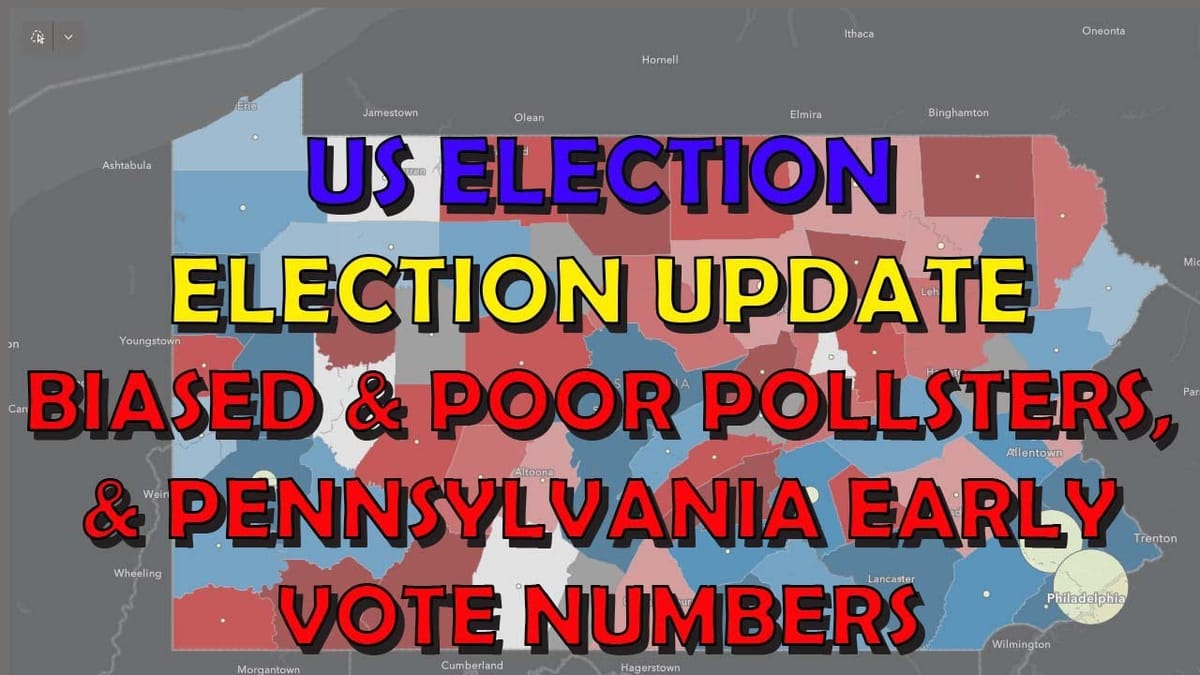
US Politics Election Extra: Biased/Poor Pollsters, Early Vote Numbers in Pennsylvania
Title:US Politics Election Extra: Biased/Poor Pollsters, Early Vote Numbers in Pennsylvania Topics:Hello Team, Poll reliability and bias, Pollster motivations and accuracy, Early Voting Data in Pennsylvania, Early Voting vs. Polling Averages , Wrap Up


🤖
This summary has been produced automatically by an AI Large Language Model (LLM) without any human intervention. Whilst every effort has been made to prompt the LLM to produce accurate output, there may be inconsistencies, inaccuracies or hallucinations!
Table of Contents 📖
"The presumption...was that every firm, their primary incentive is to be as correct as possible so they can make more money and get more clients. So we shouldn't assume anything about their motivations other than that they want to like have the most accurate numbers possible... I don't think that's what things look like now."
Hello Team
🎦 00:00-00:36⏩
Jonathan introduces the topic of the US Election, focusing on the potential impact of polls and early voter trends, specifically in Pennsylvania. He highlights the importance of Pennsylvania in the election, emphasizing that many believe "whoever wins Pennsylvania wins the election."
Return to top⤴️
Poll reliability and bias
🎦 00:36-04:25⏩
- Jonathan argues that polls can influence public opinion but cautions against blindly trusting them.
- He criticizes pollsters like Rasmussen for potential bias, citing their low rating on 538 for accuracy and transparency and their alleged connections to the Trump campaign.
- Jonathan suggests that some pollsters prioritize pushing a narrative over accuracy, particularly those favoured by right-wing media outlets.
Pollster motivations and accuracy
🎦 04:25-18:01⏩
- Jonathan discusses pollster motivations with reference to an interview on the Majority Report podcast featuring poll analyst Josh.
- He shares Josh's view that assuming all pollsters prioritize accuracy is outdated, arguing that the financial incentives have shifted.
- Jonathan points out that the most reputable pollsters are often academic institutions or large survey companies (like YouGov) as they are less driven by profit and more by reputation and data integrity.
- He contrasts this with smaller, partisan outfits, including some run by teenagers, that lack transparency and may have questionable funding sources.
- Jonathan gives examples of unreliable pollsters like Patriot Polling (run by teenagers) and SoCal, which are often included in polling averages despite their lack of credibility.
- He recommends Dave Trotter's Voting Trend channel for further analysis of polling data and methodology.
Early Voting Data in Pennsylvania
🎦 18:01-29:15⏩
- Jonathan shifts focus to early voting data, particularly in Pennsylvania, suggesting it might be a more reliable indicator than polls.
- He references analysis by Dave Trotter and Christopher Boozy, both of whom suggest that Democrats are significantly outpacing Republicans in early voting.
- Jonathan breaks down the early voting data by county, highlighting areas where Democrats are showing a strong advantage.
- He cautions that while this data suggests higher enthusiasm among Democrat voters, it's not a guarantee of the election outcome.
Early Voting vs. Polling Averages
🎦 29:15-36:54⏩
- Jonathan compares early voting trends with polling averages, noting that while polls show a tight race in Pennsylvania, the early voting data suggests a potential advantage for Democrats.
- He revisits the issue of unreliable polls, calling out those showing Trump ahead in Pennsylvania and questioning their inclusion in polling averages.
- Jonathan expresses a desire for a polling aggregator that excludes unreliable pollsters to provide a more accurate picture of the race.
Wrap Up
🎦 36:54-37:01⏩
- Jonathan concludes his "stream of consciousness" analysis, encouraging viewers to share their thoughts and opinions on the discussed topics.
🤖❓ AI Debrief (post task) - anything the AI didn't understand
Who is Christopher Boozy? Is there a link to his analysis?
It would be helpful to have links to the specific Dave Trotter videos and the Majority Report episode mentioned.
What is "Target Smart's race modeling data"?
Can you clarify what is meant by "crosstabs" in the context of poll analysis?
🤖💭 AI Plan (pre task) - the AI's step by step thought process
This is a multi-faceted task requiring me to act as an editor for "ATP Distilled", focusing on summarising video transcripts from ATP Geopolitics.
Understanding the Context
Firstly, it's crucial to grasp the essence of ATP Geopolitics and the purpose of "ATP Distilled". Jonathan's in-depth analysis of the Russia-Ukraine war is highly valuable to his audience, but the volume of content can be overwhelming. Therefore, my role is to distil this information into digestible summaries.
Task Breakdown
The tasks are clearly defined, but I need to approach them methodically:
Video Metadata: Extracting title, date (in UK format), and part of the video from the YouTube title is straightforward. XML tags will be used for clarity.
Topic Titles: This is where my editorial judgement comes into play. I need to identify distinct topics within the transcript, ensuring each title is specific, quantified, and granular. Using separate topics for different countries/regions/news items will improve clarity. The consistent use of Ukrainian spellings for place names is essential.
Topic Timeframes: Accurately recording start and end timestamps for each topic will ensure the summary covers the entire video content. This step also serves as a quality check for missed topics.
Topic Summaries: This is the core of the task, demanding a balance between conciseness and conveying Jonathan's insights effectively. Using bullet points, bold/italic emphasis (sparingly), and incorporating relevant quotes will make the summaries informative and engaging. Adhering to British English and maintaining respect for Ukraine remains crucial.
Quote Selection: Choosing a single, impactful quote that resonates with the video's message is vital. The quote should be concise and understandable out of context.
Queries: Honesty is paramount. I must highlight any uncertainties I have regarding the transcript or tasks. This feedback loop is crucial for improving transcript quality and my understanding.
Example in Action
Applying this process to the provided transcript will ensure a comprehensive and insightful summary for "ATP Distilled".