Ukraine War Update NEWS: Pt 1 - Overnight & Other News - Sumy Strife
Title:Ukraine War Update NEWS: Pt 1 - Overnight & Other News - Sumy Strife Topics:Hello Team, Ukrainian General Staff Figures for Russian Losses on 9th April 2025: 1420 Personnel, 70 Artillery Systems, 169 Vehicles, China Denies Awareness of 155 Chinese Citizens Fighting for Russia; US Expresses Con


🤖
This summary has been produced automatically by an AI Large Language Model (LLM) without any human intervention. Whilst every effort has been made to prompt the LLM to produce accurate output, there may be inconsistencies, inaccuracies or hallucinations!
Table of Contents 📖
"Who needs enemies with air defenses like that?"
🤖💭 AI Plan (pre task) - the AI's step by step thought process
My thinking process to address this request involved several steps, focusing on breaking down the complex instructions into manageable tasks and ensuring adherence to all specified rules and output format.
1. Deconstructing the Request and Instructions:
Purpose: Summarise YouTube transcripts from ATP Geopolitics ("ATP Distilled" project) in British English, targeting viewers with limited time.
Persona: Act as a diligent editor/writer, British English style.
Content Source: YouTube transcripts, focusing on Ukraine War news and analysis by Jonathan MS Pearce (ATP Geopolitics).
Output Format: XML, with specific tags for title, date, part, topic titles, topic timestamps, topic summaries, quote, and queries.
Detailed Tasks (Task 1-6): Each task is clearly defined with rules and guidance. I need to address each one systematically.
Key Constraints: British English, Ukrainian spellings, specific XML tag usage, granular topic titles, concise summaries, quote selection, query recording.
2. Planning and Strategy - Step-by-Step Breakdown:
Before even looking at the transcript, I planned the execution flow based on the task order:
Task 1 (Title, Date, Part): This is straightforward string manipulation. Extract title by removing date/part pattern, format date, extract part if present. XML tagging is simple.
Task 2 (Topic Titles): This is the most subjective and crucial task. I'll need to read through the transcript to identify distinct topics. I'll aim for granularity, avoiding combining unrelated subjects. I'll remember the "Hello Team" and "Wrap up" topics. Ukrainian spellings are a must. I'll mentally scan for topic shifts as I read.
Task 3 (Topic Timestamps): This is mechanical. Once topics are defined, I'll go back to the transcript and note the start and end timestamps for each topic. Matching `id` attributes is critical for linking timestamps to titles and summaries. I'll double-check for gaps in time to ensure I haven't missed any content or mis-segmented.
Task 4 (Topic Summaries): After titles and timestamps, I'll summarise each topic. Bullet points are specified. I need to capture key facts, Jonathan's opinions, and any mentioned sources. British English and Ukrainian spellings apply here. I will be mindful of conciseness while providing sufficient context. I'll look for opportunities to include Jonathan's personality and humour as requested.
Task 5 (Quote): As I summarise, I'll be looking for a quote that is insightful, poignant, or humorous, and makes sense on its own. It needs to be concise and impactful.
Task 6 (Queries): I will actively note anything unclear or ambiguous during the previous tasks. If everything is clear, I will explicitly state "None".
3. Pre-computation/Pre-analysis (Before Processing the Transcript):
Mental Checklist: XML tags, British English, Ukrainian spellings, granularity, conciseness, quote, queries.
Anticipate Challenges: Identifying topic boundaries precisely might be tricky. Some sentences might bridge topics. I need to make reasoned judgements. Ensuring granularity without over-segmenting is a balancing act. Correcting transcript errors (spellings, misheard words) during summarisation is also important.
4. Transcript Processing - Step-by-Step Execution:
Initial Read-through (Skimming for Topics): I quickly read the transcript to get a general sense of the topics discussed. I noted mentions of Russian losses, Chinese involvement, glide bombs, Sumy region activity, Moscow helicopter incident, drone strikes in Russia, oil refinery issues, EU trade agreement, sanctions, security guarantees, US-Russia talks, trade war, and Ukraine aid campaign. This gave me a rough topic outline.
Detailed Read-through (Task 2 - Topic Titles & Task 3 - Timestamps): I reread the transcript more carefully, sentence by sentence, to pinpoint topic beginnings and ends. I started assigning topic titles as I went.
"Hello Team" (00:00-00:29⏩) - Intro/Welcome
"Ukrainian General Staff Figures for Russian Losses on 9th April 2025: 1420 Personnel, 70 Artillery Systems, 169 Vehicles" (00:30-02:38⏩) - First data point, quantified title.
"China Denies Awareness of 155 Chinese Citizens Fighting for Russia; US Expresses Concern" (02:39-04:00⏩) - Country focus, specific numbers, geopolitical angle.
"Ukraine Strikes Bryansk Oblast Border Checkpoint with French AASM Hammer Precision Munitions" (04:01-04:31⏩) - Specific weapon type, location, action.
"Ukrainian 36th Marine Brigade Holds Back Russian Advances in Besivka, Sumy Region" (04:31-05:07⏩) - Location, unit, action.
"Videos Show Intense Fighting and Footage from Sumy Area Border Region" (05:07-06:19⏩) - General area focus, acknowledging video evidence.
"Conflicting Reports on Helicopter Incident Over Moscow: Russian Downed Own or Ukrainian Drone?" (06:20-08:26⏩) - Uncertainty, conflicting narratives, location.
"Ukrainian Forces Destroy Russian Merlin Drone Worth $300,000" (08:26-09:02⏩) - Specific equipment, value, action.
"Russia Launches 145 Drones Overnight into Ukraine; Kyiv Claims 85 Shot Down" (09:02-10:08⏩) - Quantified attack, locations, interception rate.
"Russian Shahid Drones May Be Modified to Drop Fragmentation Grenades" (10:08-10:30⏩) - Potential weapon modification, source (Max24).
"Nikopol Under Heavy Russian Attack: 12 Injuries, Dormitory and Mobile Phone Mast Hit" (10:30-11:58⏩) - Location, casualties, target types, severity.
"Drone Strike Reported in Aleksandrovskoe, Stavropol Region, Russia" (11:58-12:15⏩) - Location, type of strike, uncertainty about target.
"Ballistic Missile Attack on Dnipro; Details Awaited" (12:15-12:24⏩) - Location, weapon type, immediacy.
"Ukrainian Drones Reportedly Strike Sverdlov Explosives Plant in Dzerzhinsk, Russia" (12:24-12:48⏩) - Location, target type, Ukrainian source.
"Fire at Oil Refinery in Komsomolsk-on-Amur, Khabarovsk Region, Russia" (12:48-13:14⏩) - Location, event type, uncertainty about cause.
"Multiple Russian Refineries Halting Production Due to Losses from Attacks, Export Restrictions" (13:14-14:00⏩) - Broader economic impact, multiple refineries, causes.
"Financial Losses Across Russian Oil and Gas Industry Reported by Max24" (14:00-15:27⏩) - Specific financial details, source credit, wider industry impact.
"Ukraine-EU Transport Visa-Free Agreement Extended to End of 2025" (15:27-16:31⏩) - Policy update, timeframe, positive impact for Ukraine, potential negative for EU farmers.
"Ex-Russian Proxy in Crimea Convicted in London for Breaching UK Sanctions" (16:31-17:20⏩) - Legal action, individual's role, location of conviction.
"UK and France Host 'Coalition of the Willing' Meeting in Brussels on Security Guarantees for Ukraine" (17:20-17:51⏩) - Diplomatic event, location, purpose, key countries.
"Bloomberg Reports US Lack of Commitment Stalling 'Coalition of the Willing' Security Guarantees" (17:51-19:07⏩) - Negative development, source credit (Bloomberg), key issue (US backstop).
"US-Russia Talks Held in Istanbul, Reportedly Not About Ukraine War, Focus on Bilateral Relations" (19:07-19:54⏩) - Diplomatic talks, location, surprising focus (not Ukraine), potential normalization implication.
"Russia to Ban Re-entry for Foreign Companies Funding Ukraine's Army" (19:54-20:30⏩) - Retaliatory measure, specific criteria for ban.
"Trump Pauses Planned Trade War Tariffs for 90 Days Amidst Bond Market Concerns" (20:30-21:43⏩) - Trade policy shift, timeframe, reason (bond market/Japan), source (Fox News).
"EU Also Pauses Counter-Tariffs on US Goods for 90 Days to Allow Negotiations" (21:43-22:21⏩) - EU response, mirroring US pause, timeframe, negotiation focus.
"US 'Authoritarian' Approach to Foreign Relations Criticized; Concern for Ukraine Amidst Global Distractions" (22:21-23:39⏩) - Broader geopolitical commentary, value judgement on US, Ukraine plight reminder.
"Wrap up" (23:39-end⏩) - Sign-off, Ukraine car campaign mention, thanks.
For each topic, I noted the start and end times directly from the transcript.
Task 4 - Topic Summaries: I went through each topic title and wrote a concise summary, focusing on key information, Jonathan's insights, and using bullet points. I corrected any spelling or grammatical errors from the transcript and ensured Ukrainian place names were correct (Kyiv, not Kiev). I paid attention to including sources mentioned by Jonathan (Andrew Perpetua, Max24, Kiev Independent, Fox News, Bloomberg, Anton Garashchenko, Edward Hunter Christie, Senator Scott Weiner, Ursula von der Leyen, Tim White, Noel reports). I tried to capture the essence of Jonathan's analysis and opinions within the summaries.
Task 5 - Quote Selection: I reread the summaries and the transcript looking for a quote. I chose "Who needs enemies with air defenses like that?" as it is concise, humorous, and captures Jonathan's commentary on the Russian helicopter incident, making sense even out of context.
Task 6 - Queries: During the process, I didn't encounter any significant ambiguities or misunderstandings. Therefore, I put "None" in the `🤖❓ AI Debrief (post task) - anything the AI didn't understand ` section.
XML Formatting: Finally, I assembled all the pieces into the XML format, carefully checking for correct tag names, closing tags, and the overall structure as defined in the instructions. I double-checked `id` attributes for `topictitle`, `topicts`, and `topicsummary` to ensure they matched for each topic. I verified the date format and British English spelling throughout.
This systematic, step-by-step approach, combined with attention to detail and cross-referencing the instructions at each stage, allowed me to generate the XML summary accurately and comprehensively. The initial skimming helped me grasp the overall flow, while the detailed read-throughs were crucial for precise topic segmentation and summary writing. Regularly checking against the instructions prevented errors and ensured all requirements were met.
Hello Team
🎦 00:00-00:29⏩
- Jonathan welcomes viewers to the Ukraine War News Update, part one for the 10th of April 2025.
- He mentions this is the last day he will be away and will be back to a more usual schedule from tomorrow.
- Due to being away from home, he has only been able to release one video per day.
- This video will cover the Ukrainian General Staff figures for Russian losses from the previous day (9th April).
- Jonathan apologises that this video is being released later than usual due to a mistake on his part.
🪦 DISCLAIMER FOR GENERAL STAFF LOSSES DATA
- These are real people with real lives and real families who love them. Don’t let the numbers sap your humanity.
- These numbers probably aren’t accurate but they’re the best we have and we don’t need them to be accurate to be indicative of patterns of activity.
- All losses are estimates. Losses cannot be counted with accuracy because of the conditions on the ground.
- Both sides would see it to be of their advantage to minimize their own losses maximize the other side’s losses.
- Neither side releases their losses but we have enough transparency from the Ukrainian side to have confidence in they are indicative.
- Personnel losses are hard to count. If a soldier gets injured, heals up, and returns to the front line only to get injured again, is that one loss or two? Also, how to deal with losses from PMC’s or soldiers fighting with RF from occupied territories?
- Equipment losses are hard to count. If an AA complex involves several parts and one part gets disabled, is that a loss, or a fraction of a loss? If a tank gets disabled, repaired, back into the fight, then disabled again, is that one lost tank or two?
- All recorded losses are vulnerable to multiple reporting. We have already seen numerous cases of multiple drones in the air reporting the same loss from different angles as multiple engagements.
- Losses are not always reported on the same day they occurred. It is frequent that drone losses are reported at least 24 hours after other terrestrial equipment losses. Certain losses may not be reported for days or weeks for military intelligence reasons.
Ukrainian General Staff Figures for Russian Losses on 9th April 2025: 1420 Personnel, 70 Artillery Systems, 169 Vehicles
🎦 00:30-02:38⏩
- Ukrainian General Staff figures for 9th April report 1,420 Russian personnel losses, an increase from the previous day.
- Three tanks were lost, a low number.
- Twelve troop-carrying armoured fighting vehicles were destroyed, half the daily average.
- A significant 70 artillery systems were destroyed. Jonathan highlights the consistent effectiveness of Ukrainian forces in this area.
- A very high number of 169 vehicles and fuel tanks were destroyed, indicating potentially increased Russian offensive actions.
- Four pieces of special equipment were also lost by Russia.
- Andrew Perpetua's loss list is not currently available, possibly due to the volume of videos to analyse.
- The figures suggest intensified Russian attacks in several areas.
China Denies Awareness of 155 Chinese Citizens Fighting for Russia; US Expresses Concern
🎦 02:39-04:00⏩
- China claims to be unaware of over 155 Chinese citizens allegedly fighting for Russia, a figure mentioned by President Zelenskyy.
- The Chinese Foreign Minister states China is a firm supporter of peaceful resolution, suggesting any Chinese fighters are acting as mercenaries and not state-sponsored.
- The US has expressed concern, recalling the capture of two Chinese POWs amongst a group of six fighters recently.
Ukraine Strikes Bryansk Oblast Border Checkpoint with French AASM Hammer Precision Munitions
🎦 04:01-04:31⏩
- Video footage shows Ukraine using French-made AASM Hammer precision-guided munitions.
- A Ukrainian MiG-29 fighter jet precisely bombed a border checkpoint in Bryansk Oblast, Russia, north of the Ukrainian border, near Belarus.
- Jonathan notes the increasing use, or at least increased footage, of these precision munitions by Ukraine.
Ukrainian 36th Marine Brigade Holds Back Russian Advances in Besivka, Sumy Region
🎦 04:31-05:07⏩
- Operators from the Ukrainian 36th Marine Brigade are reportedly holding back Russian advances in Besivka, Sumy border region.
- Besivka has been in the grey zone for weeks, according to NOL reports.
- Ukrainian forces conduct raids into the village, taking POWs, while Russia attempts to push further south.
Videos Show Intense Fighting and Footage from Sumy Area Border Region
🎦 05:07-06:19⏩
- Jonathan directs viewers to videos linked in the description showing footage from the Sumy area, highlighting the intensity of activity there.
- The guided glide bomb attack in Bryansk and fighting in Sumy indicate significant action in this northern border region.
- Another video shows a Russian infantry group ambushed in the Sumy region by the Ukrainian 82nd Air Assault Brigade, resulting in eliminated personnel.
- Jonathan shows this video to emphasise the level of fighting in the Sumy area.
Conflicting Reports on Helicopter Incident Over Moscow: Russian Downed Own or Ukrainian Drone?
🎦 06:20-08:26⏩
- A helicopter was filmed being hit by air defences over Moscow.
- Initial claims suggest Russian air defences mistakenly shot down their own helicopter, spooked by potential threats. Jonathan jokes "Who needs enemies with air defences like that?". He has previously discussed the risk of light aircraft and drones in Russia due to heightened air defence alertness.
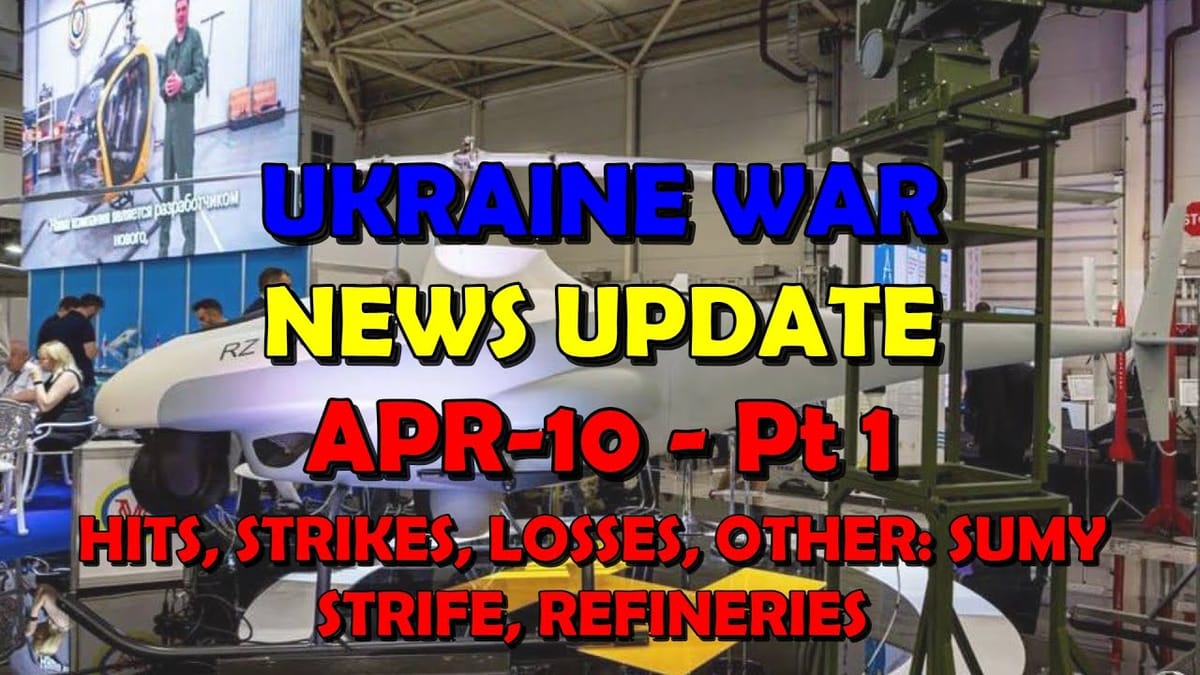
- Russian mill bloggers, including MAKS24, suggest it may have been a Ukrainian drone helicopter, specifically an RZ-500 drone, attacking Narofominsk near Moscow.
- Russian channels propose that Russian air defence mistook a Ukrainian drone for their own helicopter.
- Jonathan is sceptical of the Russian drone helicopter narrative, finding it unlikely given the apparent size of the helicopter in the footage.
- More details are expected to emerge.
Ukrainian Forces Destroy Russian Merlin Drone Worth $300,000
🎦 08:26-09:02⏩
- Video footage shows a Russian Merlin drone being destroyed by Ukrainian forces.
- These drones are reported to be expensive, worth approximately $300,000.
- Jonathan speculates on its specifications and compares it to MQ-9 drones, but is unsure about the Merlin drone's exact capabilities.
Russia Launches 145 Drones Overnight into Ukraine; Kyiv Claims 85 Shot Down
🎦 09:02-10:08⏩
- Russia launched a large drone attack overnight, with 145 drones deployed against Ukraine.
- This marks a return to higher drone attack numbers after a recent decrease, possibly suggesting a previous disruption to Russian drone production or warehousing that has now been resolved.
- Kyiv claims to have shot down 85 of the drones (approximately 80%), a significantly improved interception rate compared to the ~20% seen recently.
- 11 drones reportedly got through, and 49 fell harmlessly or were disabled by electronic warfare.
- Donetsk, Kharkiv, Khmelnytskyi, Poltava and Mykolaiv (misspelled as Mikhailov in transcript) regions were targeted.
Russian Shahid Drones May Be Modified to Drop Fragmentation Grenades
🎦 10:08-10:30⏩
- Reports from MAKS24 indicate that Russian Shahid drones may now be dropping ammunition that detonates with fragmentation grenade elements.
- Kyiv residents reportedly heard these sounds during the recent drone attack.
- This suggests a potential modification of Shahid drones to act as bomber drones. Further details are awaited.
Nikopol Under Heavy Russian Attack: 12 Injuries, Dormitory and Mobile Phone Mast Hit
🎦 10:30-11:58⏩
- Nikopol was heavily attacked by Russian forces yesterday, resulting in 12 injuries.
- The city is located across the Zaporizhzhia Reservoir from Enerhodar and the Zaporizhzhia Nuclear Power Plant and is frequently shelled.
- A Kamikaze drone hit a dormitory in Nikopol.
- A mobile phone mast, vital for communication in a town often without power, was also hit by a Russian drone.
- The youngest victim is 16 years old and in serious condition.
Drone Strike Reported in Aleksandrovskoe, Stavropol Region, Russia
🎦 11:58-12:15⏩
- Another drone strike has been reported inside Russia, with video of an explosion in Aleksandrovskoe, Stavropol region.
- Jonathan is unsure if this location represents a significant military target.
Ballistic Missile Attack on Dnipro; Details Awaited
🎦 12:15-12:24⏩
- A ballistic missile attack on Dnipro has occurred this morning. Details are still emerging.
Ukrainian Drones Reportedly Strike Sverdlov Explosives Plant in Dzerzhinsk, Russia
🎦 12:24-12:48⏩
- Ukrainian drones reportedly struck the Sverdlov explosives plant in Dzerzhinsk, Nizhny Novgorod region, Russia, likely last night.
- Ukrainian sources claim at least three drones hit the facility, damaging a pipeline overpass and two workshops.
- This indicates a targeted attack on a Russian explosives production facility.
Fire at Oil Refinery in Komsomolsk-on-Amur, Khabarovsk Region, Russia
🎦 12:48-13:14⏩
- Russian Telegram channels report a fire at an oil refinery in Komsomolsk-on-Amur, Khabarovsk region, Russia.
- The fire spread to approximately 300 square metres.
- No official cause has been given, but a strike is suspected.
Multiple Russian Refineries Halting Production Due to Losses from Attacks, Export Restrictions
🎦 13:14-14:00⏩
- At least three Russian refineries – Tuapse, Ilsk, and Novosakhtensky – have reportedly halted or reduced production.
- This is attributed to significant financial losses caused by Ukrainian attacks, export restrictions, and rising raw material prices.
- The Russian oil industry is facing difficulties.
Financial Losses Across Russian Oil and Gas Industry Reported by Max24
🎦 14:00-15:27⏩
- MAKS24 reports substantial financial losses in the Russian oil and gas sector for 2024:
- Novoshakhtensky Refinery: 1.9 billion rubles loss.
- Tuapse Refinery: Over 1.2 billion rubles loss.
- Ilsk Refinery: Approximately 600 million rubles loss.
- Kuibyshev Refinery: 900 million rubles loss.
- Volgograd Refinery: Reduced processing by 30%, 1 billion rubles loss.
- Krasnodar Refinery: Lost 35% capacity, 750 million rubles loss.
- Saratov's Ryazan refinery: Production shutdown due to drone attack in March 2024.
- Astrakhan gas processing plant: Drone attack in February 2024.
- Cisran refinery: Drone attack in March 2024.
- Slavyansk refinery: Fire after drone attack in March 2024, temporary shutdown.
- Kaluga refinery: Drone attack in March 2024.
- Saratov's net profit down 38.5%, 600 million rubles.
- PJSC Gazprom Neft: 25.2% decrease in net profit for 2024.
- PJSC Gazprom: Net loss of 309 billion rubles for the first nine months of 2024.
- Jonathan emphasises the severe impact of attacks on Russia's hydrocarbon industry, a critical source of revenue for the war effort. He believes Ukrainian strikes are strategically effective.
Ukraine-EU Transport Visa-Free Agreement Extended to End of 2025
🎦 15:27-16:31⏩
- The transport visa-free agreement between Ukraine and the EU has been extended until the end of 2025.
- This allows Ukrainian carriers to operate without special permits, boosting Ukrainian exports (by 42%) and imports (by 37%) according to Prime Minister Denys Shmyhal.
- Jonathan notes this could cause resentment from farmers in Poland, Hungary, and Slovakia who may perceive it as unfair competition due to less bureaucracy and costs for Ukrainian carriers.
Ex-Russian Proxy in Crimea Convicted in London for Breaching UK Sanctions
🎦 16:31-17:20⏩
- In a first case of its kind, Dmitry Ovsyanikov, a former Russian proxy in Crimea, has been convicted in a London court for breaching UK sanctions.
- He was found guilty on six of seven counts of circumventing sanctions between February 2023 and January 2024.
- Jonathan views this as positive news, demonstrating that sanctions enforcement is being taken seriously.
UK and France Host 'Coalition of the Willing' Meeting in Brussels on Security Guarantees for Ukraine
🎦 17:20-17:51⏩
- The UK and France are hosting a meeting of the "Coalition of the Willing" in Brussels, bringing together defence ministers from around 30 countries.
- The meeting aims to discuss security guarantees and lasting peace for Ukraine.
- Jonathan considers this good news, but notes reports suggesting potential issues.
Bloomberg Reports US Lack of Commitment Stalling 'Coalition of the Willing' Security Guarantees
🎦 17:51-19:07⏩
- Bloomberg reports that the "Coalition of the Willing's" efforts to provide security guarantees to Ukraine are facing delays due to a lack of commitment from the US.
- Allied nations reportedly desire a US "backstop" for security guarantees, potentially involving US support with aviation, targeting, and intelligence alongside European ground troops.
- Figures like Keir Starmer and Macron reportedly believe European security guarantees alone are insufficient without US backing.
- The US is currently perceived as "recalcitrant," raising questions about the future of negotiations and security arrangements for Ukraine if the US does not participate.
US-Russia Talks Held in Istanbul, Reportedly Not About Ukraine War, Focus on Bilateral Relations
🎦 19:07-19:54⏩
- US-Russia talks have commenced in Istanbul.
- Reportedly, the discussions will not focus on the war in Ukraine but instead on US-Russia bilateral relations.
- This suggests a focus on normalising relations, potentially reopening embassies and resuming trade.
- Jonathan expresses a "bitter taste" at the idea of the US seemingly normalising relations with Russia while the Ukraine war continues.
- The closed-door consultations lasted around six hours, with details undisclosed.
Russia to Ban Re-entry for Foreign Companies Funding Ukraine's Army
🎦 19:54-20:30⏩
- Russian media reports that foreign companies funding the Ukrainian army will face a re-entry ban into Russia.
- Preliminary criteria suggest that foreign firms with a "hostile position," those financing Ukraine's armed forces, or classified as "undesirable organisations" or "foreign agents" will be barred from returning to work in Russia.
Trump Pauses Planned Trade War Tariffs for 90 Days Amidst Bond Market Concerns
🎦 20:30-21:43⏩
- Trump has paused his planned trade war tariffs for 90 days.
- Jonathan suggests this pause is likely due to heavy lobbying against the tariffs, which are considered "insane".
- Fox News reports that the delay is linked to Japan's selling of US debt holdings, causing bond market sell-offs, not China as initially thought.
- Financial executives reportedly indicated Japan's actions, not China's, forced Trump to pause the tariffs.
- While Trump may portray this as a strategic pause to pressure nations to negotiate, Jonathan believes it reflects the unpopularity and negative consequences of the tariffs.
EU Also Pauses Counter-Tariffs on US Goods for 90 Days to Allow Negotiations
🎦 21:43-22:21⏩
- Anton Garashchenko reports that the EU will also pause planned counter-tariffs on US goods for 90 days, mirroring Trump's pause.
- Ursula von der Leyen states the EU took note of Trump's announcement and wants to give negotiations a chance.
- However, she warns that countermeasures will be implemented if negotiations are unsatisfactory.
- Jonathan suggests this may lead to concessions from other nations, with the US potentially getting its way in trade negotiations, but at the cost of damage to stock markets and US reputation.
US 'Authoritarian' Approach to Foreign Relations Criticized; Concern for Ukraine Amidst Global Distractions
🎦 22:21-23:39⏩
- Edward Hunter Christie criticises the "Trumpist approach" to foreign relations as unacceptable.
- He expresses sympathy for European governments forced to politely negotiate with a long-time ally to stop them from destroying existing ties.
- Senator Scott Weiner condemns these "fascists" and highlights a White House tweet stating "do not retaliate and you will be rewarded," seeing it as evidence of an authoritarian US direction.
- Jonathan concludes that the US seems to be moving towards authoritarianism, while Europe is unsure how to respond.
- He urges viewers not to be distracted from the ongoing plight of Ukraine and Russian aggression amidst these global political developments.
Wrap up
🎦 23:39-25:00⏩
- Jonathan concludes by saying these are very interesting times and he will keep viewers updated.
- He acknowledges there wasn't a huge amount of content today but hopes there were still some "nuggets" of information.
- He thanks viewers for their support and reminds them of the "Car for Ukraine" Easter Pesanky campaign.
- He mentions his personal fundraising is at £2,365, which is great, but he aims to push it further when he returns home to get closer to the overall target of £220,000 (currently at £75,000).
- He lists some of the prominent names involved in the campaign and encourages viewers to help if they can, with a link in the description.
- He signs off, thanking viewers again and promising to speak to them soon.
🤖❓ AI Debrief (post task) - anything the AI didn't understand
None
🤖💭 AI Plan (pre task) - the AI's step by step thought process
My thinking process to address this request involved several steps, focusing on breaking down the complex instructions into manageable tasks and ensuring adherence to all specified rules and output format.
1. Deconstructing the Request and Instructions:
Purpose: Summarise YouTube transcripts from ATP Geopolitics ("ATP Distilled" project) in British English, targeting viewers with limited time.
Persona: Act as a diligent editor/writer, British English style.
Content Source: YouTube transcripts, focusing on Ukraine War news and analysis by Jonathan MS Pearce (ATP Geopolitics).
Output Format: XML, with specific tags for title, date, part, topic titles, topic timestamps, topic summaries, quote, and queries.
Detailed Tasks (Task 1-6): Each task is clearly defined with rules and guidance. I need to address each one systematically.
Key Constraints: British English, Ukrainian spellings, specific XML tag usage, granular topic titles, concise summaries, quote selection, query recording.
2. Planning and Strategy - Step-by-Step Breakdown:
Before even looking at the transcript, I planned the execution flow based on the task order:
Task 1 (Title, Date, Part): This is straightforward string manipulation. Extract title by removing date/part pattern, format date, extract part if present. XML tagging is simple.
Task 2 (Topic Titles): This is the most subjective and crucial task. I'll need to read through the transcript to identify distinct topics. I'll aim for granularity, avoiding combining unrelated subjects. I'll remember the "Hello Team" and "Wrap up" topics. Ukrainian spellings are a must. I'll mentally scan for topic shifts as I read.
Task 3 (Topic Timestamps): This is mechanical. Once topics are defined, I'll go back to the transcript and note the start and end timestamps for each topic. Matching `id` attributes is critical for linking timestamps to titles and summaries. I'll double-check for gaps in time to ensure I haven't missed any content or mis-segmented.
Task 4 (Topic Summaries): After titles and timestamps, I'll summarise each topic. Bullet points are specified. I need to capture key facts, Jonathan's opinions, and any mentioned sources. British English and Ukrainian spellings apply here. I will be mindful of conciseness while providing sufficient context. I'll look for opportunities to include Jonathan's personality and humour as requested.
Task 5 (Quote): As I summarise, I'll be looking for a quote that is insightful, poignant, or humorous, and makes sense on its own. It needs to be concise and impactful.
Task 6 (Queries): I will actively note anything unclear or ambiguous during the previous tasks. If everything is clear, I will explicitly state "None".
3. Pre-computation/Pre-analysis (Before Processing the Transcript):
Mental Checklist: XML tags, British English, Ukrainian spellings, granularity, conciseness, quote, queries.
Anticipate Challenges: Identifying topic boundaries precisely might be tricky. Some sentences might bridge topics. I need to make reasoned judgements. Ensuring granularity without over-segmenting is a balancing act. Correcting transcript errors (spellings, misheard words) during summarisation is also important.
4. Transcript Processing - Step-by-Step Execution:
Initial Read-through (Skimming for Topics): I quickly read the transcript to get a general sense of the topics discussed. I noted mentions of Russian losses, Chinese involvement, glide bombs, Sumy region activity, Moscow helicopter incident, drone strikes in Russia, oil refinery issues, EU trade agreement, sanctions, security guarantees, US-Russia talks, trade war, and Ukraine aid campaign. This gave me a rough topic outline.
Detailed Read-through (Task 2 - Topic Titles & Task 3 - Timestamps): I reread the transcript more carefully, sentence by sentence, to pinpoint topic beginnings and ends. I started assigning topic titles as I went.
"Hello Team" (00:00-00:29⏩) - Intro/Welcome
"Ukrainian General Staff Figures for Russian Losses on 9th April 2025: 1420 Personnel, 70 Artillery Systems, 169 Vehicles" (00:30-02:38⏩) - First data point, quantified title.
"China Denies Awareness of 155 Chinese Citizens Fighting for Russia; US Expresses Concern" (02:39-04:00⏩) - Country focus, specific numbers, geopolitical angle.
"Ukraine Strikes Bryansk Oblast Border Checkpoint with French AASM Hammer Precision Munitions" (04:01-04:31⏩) - Specific weapon type, location, action.
"Ukrainian 36th Marine Brigade Holds Back Russian Advances in Besivka, Sumy Region" (04:31-05:07⏩) - Location, unit, action.
"Videos Show Intense Fighting and Footage from Sumy Area Border Region" (05:07-06:19⏩) - General area focus, acknowledging video evidence.
"Conflicting Reports on Helicopter Incident Over Moscow: Russian Downed Own or Ukrainian Drone?" (06:20-08:26⏩) - Uncertainty, conflicting narratives, location.
"Ukrainian Forces Destroy Russian Merlin Drone Worth $300,000" (08:26-09:02⏩) - Specific equipment, value, action.
"Russia Launches 145 Drones Overnight into Ukraine; Kyiv Claims 85 Shot Down" (09:02-10:08⏩) - Quantified attack, locations, interception rate.
"Russian Shahid Drones May Be Modified to Drop Fragmentation Grenades" (10:08-10:30⏩) - Potential weapon modification, source (Max24).
"Nikopol Under Heavy Russian Attack: 12 Injuries, Dormitory and Mobile Phone Mast Hit" (10:30-11:58⏩) - Location, casualties, target types, severity.
"Drone Strike Reported in Aleksandrovskoe, Stavropol Region, Russia" (11:58-12:15⏩) - Location, type of strike, uncertainty about target.
"Ballistic Missile Attack on Dnipro; Details Awaited" (12:15-12:24⏩) - Location, weapon type, immediacy.
"Ukrainian Drones Reportedly Strike Sverdlov Explosives Plant in Dzerzhinsk, Russia" (12:24-12:48⏩) - Location, target type, Ukrainian source.
"Fire at Oil Refinery in Komsomolsk-on-Amur, Khabarovsk Region, Russia" (12:48-13:14⏩) - Location, event type, uncertainty about cause.
"Multiple Russian Refineries Halting Production Due to Losses from Attacks, Export Restrictions" (13:14-14:00⏩) - Broader economic impact, multiple refineries, causes.
"Financial Losses Across Russian Oil and Gas Industry Reported by Max24" (14:00-15:27⏩) - Specific financial details, source credit, wider industry impact.
"Ukraine-EU Transport Visa-Free Agreement Extended to End of 2025" (15:27-16:31⏩) - Policy update, timeframe, positive impact for Ukraine, potential negative for EU farmers.
"Ex-Russian Proxy in Crimea Convicted in London for Breaching UK Sanctions" (16:31-17:20⏩) - Legal action, individual's role, location of conviction.
"UK and France Host 'Coalition of the Willing' Meeting in Brussels on Security Guarantees for Ukraine" (17:20-17:51⏩) - Diplomatic event, location, purpose, key countries.
"Bloomberg Reports US Lack of Commitment Stalling 'Coalition of the Willing' Security Guarantees" (17:51-19:07⏩) - Negative development, source credit (Bloomberg), key issue (US backstop).
"US-Russia Talks Held in Istanbul, Reportedly Not About Ukraine War, Focus on Bilateral Relations" (19:07-19:54⏩) - Diplomatic talks, location, surprising focus (not Ukraine), potential normalization implication.
"Russia to Ban Re-entry for Foreign Companies Funding Ukraine's Army" (19:54-20:30⏩) - Retaliatory measure, specific criteria for ban.
"Trump Pauses Planned Trade War Tariffs for 90 Days Amidst Bond Market Concerns" (20:30-21:43⏩) - Trade policy shift, timeframe, reason (bond market/Japan), source (Fox News).
"EU Also Pauses Counter-Tariffs on US Goods for 90 Days to Allow Negotiations" (21:43-22:21⏩) - EU response, mirroring US pause, timeframe, negotiation focus.
"US 'Authoritarian' Approach to Foreign Relations Criticized; Concern for Ukraine Amidst Global Distractions" (22:21-23:39⏩) - Broader geopolitical commentary, value judgement on US, Ukraine plight reminder.
"Wrap up" (23:39-end⏩) - Sign-off, Ukraine car campaign mention, thanks.
For each topic, I noted the start and end times directly from the transcript.
Task 4 - Topic Summaries: I went through each topic title and wrote a concise summary, focusing on key information, Jonathan's insights, and using bullet points. I corrected any spelling or grammatical errors from the transcript and ensured Ukrainian place names were correct (Kyiv, not Kiev). I paid attention to including sources mentioned by Jonathan (Andrew Perpetua, Max24, Kiev Independent, Fox News, Bloomberg, Anton Garashchenko, Edward Hunter Christie, Senator Scott Weiner, Ursula von der Leyen, Tim White, Noel reports). I tried to capture the essence of Jonathan's analysis and opinions within the summaries.
Task 5 - Quote Selection: I reread the summaries and the transcript looking for a quote. I chose "Who needs enemies with air defenses like that?" as it is concise, humorous, and captures Jonathan's commentary on the Russian helicopter incident, making sense even out of context.
Task 6 - Queries: During the process, I didn't encounter any significant ambiguities or misunderstandings. Therefore, I put "None" in the `🤖❓ AI Debrief (post task) - anything the AI didn't understand ` section.
XML Formatting: Finally, I assembled all the pieces into the XML format, carefully checking for correct tag names, closing tags, and the overall structure as defined in the instructions. I double-checked `id` attributes for `topictitle`, `topicts`, and `topicsummary` to ensure they matched for each topic. I verified the date format and British English spelling throughout.
This systematic, step-by-step approach, combined with attention to detail and cross-referencing the instructions at each stage, allowed me to generate the XML summary accurately and comprehensively. The initial skimming helped me grasp the overall flow, while the detailed read-throughs were crucial for precise topic segmentation and summary writing. Regularly checking against the instructions prevented errors and ensured all requirements were met.