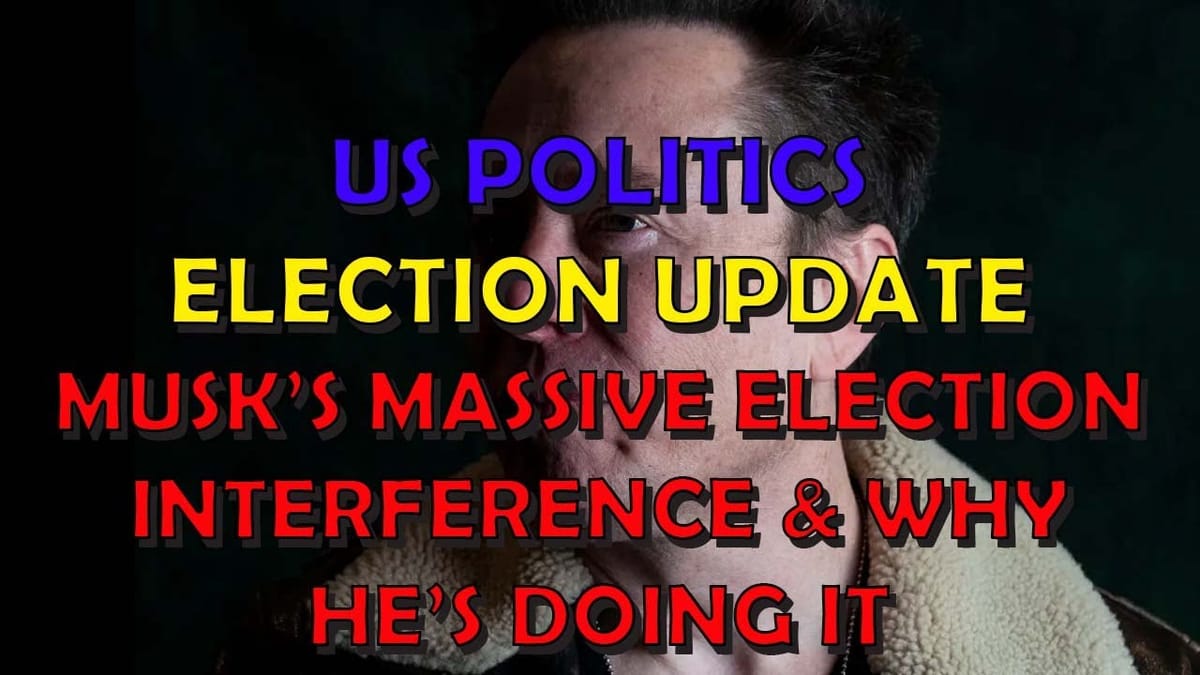
US Politics Election Extra: Musk's Massive Election 'Interference & Why He's Doing It
Title:US Politics Election Extra: Musk's Massive Election 'Interference & Why He's Doing It Topics:Hello Team, Elon Musk's Support for Trump: From Denial to $75 Million Donation, Musk's Unconventional Political Involvement: Rallies and Financial Incentives, Musk's Million-Dollar Lottery: Legality Qu


🤖
This summary has been produced automatically by an AI Large Language Model (LLM) without any human intervention. Whilst every effort has been made to prompt the LLM to produce accurate output, there may be inconsistencies, inaccuracies or hallucinations!
Table of Contents 📖
"If you're wondering why Musk is going hammer and tongs at trying to get Trump elected, this is it: follow the money and follow the power, where power probably does derive to money."
Hello Team
🎦 00:00-00:31⏩
- Jonathan welcomes viewers to a US Election special about Elon Musk's support for Donald Trump and the GOP.
- He plans to break down the US election content into smaller parts for easier consumption.
- Jonathan notes Musk's recent actions are worrying.
Elon Musk's Support for Trump: From Denial to $75 Million Donation
🎦 00:31-02:50⏩
- Initially, Musk claimed he wouldn't donate to either presidential candidate.
- Four months later, he established the "America Super PAC" advocating for "common sense" and "centrist values" while echoing extreme right-wing talking points.
- Musk donated $75 million to his Super PAC to support Trump's re-election, contradicting his earlier statement.
- Miriam Adelson, who received a controversial medal of honour from Trump, also contributed $95 million to a pro-Trump Super PAC.
- These donations significantly boosted Trump's campaign funds, which were lagging behind the Democrats.
Musk's Unconventional Political Involvement: Rallies and Financial Incentives
🎦 02:51-06:13⏩
- Business Insider highlights Musk's unique approach as a pro-Trump megadonor, including holding his own political rallies in Pennsylvania.
- America Super PAC offered $47 to individuals for getting supporters to sign a petition, providing valuable voter data.
- Musk increased the offer to $100 for every Pennsylvania voter who signs.
- Journalist Roger Lowenstein notes that despite his wealth, Musk isn't the biggest donor (Timothy Mellon spent $165 million).
- Musk's direct involvement in campaigning through rallies, financial incentives, and a Super PAC is unprecedented for someone of his wealth and stature.
Musk's Million-Dollar Lottery: Legality Questioned
🎦 06:13-09:08⏩
- Musk offered a daily $1 million prize to a petition signer supporting the US Constitution, awarding the first to John Dreher at a Pennsylvania event.
- This use of wealth to influence the election raises concerns about potential vote buying.
- Richard L. Hasen, an election law expert, argues that Musk's lottery is illegal, citing 52 U.S.C. 10307c, which prohibits offering payment for registration or voting.
- The Department of Justice's Election Crimes Manual defines vote buying as anything of monetary value, including lottery chances.
- Musk founded America Super PAC to funnel his and other wealthy individuals' money into pro-Trump voter registration and persuasion efforts.
Musk-Funded Dark Money Network: Fake Harris Websites and Texts
🎦 09:08-12:07⏩
- Beyond financial incentives, Musk's pro-Trump dark money network is engaging in deceptive tactics, such as setting up fake Kamala Harris websites.
- These websites and associated text messages spread contradictory information about Harris to different target audiences.
- Josh Marshall reveals that "Progress 2028," presented as Harris's liberal counterpart to the Conservative Heritage Foundation's "Project 2025," is a front for this dark money network.
- The network is funded by Musk and aims to manipulate voters through disinformation.
- Another source points out the potential illegality of impersonating the Harris campaign, referencing Title 18 U.S.C. 2241c (US vs. Mackie).
Progress 2028: Disseminating Misleading Information and Exploiting Divisions
🎦 12:08-14:42⏩
- Opensecrets.org provides details about "Progress 2028" and the dark money network behind it.
- The website promotes disproven and misleading claims about Harris's positions to damage her image.
- It falsely attributes policies like empowering undocumented immigrants and banning fracking to Harris, contradicting her public statements.
- The network uses divisive tactics, targeting different voter segments with contradictory information, including anti-Jewish and anti-Islamic messages.
- Jonathan expresses disappointment and concern over these tactics.
Future Coalition PAC: Targeting Jewish and Arab-American Voters with Disinformation
🎦 14:42-17:17⏩
- Future Coalition PAC, another project funded by Building America's Future (Musk's dark money group), is running ads to manipulate Jewish and Arab-American voters.
- It spreads lies about Harris's stance on Israel, portraying her as either too pro-Israel or too pro-Palestinian to different audiences.
- The PAC's funding comes from Building America's Future, which doesn't disclose its donors, but the Wall Street Journal identified Musk as a backer.
- Musk's increasing influence on Trump's political operation and get-out-the-vote efforts is highlighted.
- He donated nearly $75 million to America Super PAC, becoming a crucial source of pro-Trump field organising.
- Building America's Future also offers $5 million rewards for evidence of voter fraud, aligning with Musk's interest in the topic.
- Jonathan expresses his concern about Musk's increasing influence on the election.
Musk's Motivation: Self-Interest and Potential Legal Troubles
🎦 17:17-18:48⏩
- Ron Filipkowski questions why Musk resorts to deceptive tactics instead of campaigning for Trump based on his merits and ideas.
- Jonathan believes Musk's actions are driven by self-interest and potential legal repercussions.
- Dave Troy suggests that violations of the Foreign Agents Registration Act (FARA) and 18 U.S.C. 951 could lead to Musk's imprisonment if Trump loses.
- Musk himself joked in an interview with Tucker Carlson that he might go to jail if Trump doesn't win.
- Other potential charges against Musk include fraud, securities violations, campaign violations, and illegal drug possession.
Musk's Conflicts of Interest: Government Contractor Campaigning for Deregulation
🎦 18:48-23:43⏩
- Eric Lipton reveals that Musk is involved in disputes with numerous federal agencies (FAA, DoG, FCC, FTC, etc.).
- Musk has urged Trump to appoint him to a government efficiency commission with the power to cut regulations.
- The New York Times article "US Agencies Fund and Fight With Elon Musk" exposes Musk's extensive and lucrative government contracts.
- SpaceX influences NASA's rocket launch schedule, the Defense Department relies on it for satellite launches, and his companies received $3 billion in government contracts last year.
- This creates a massive conflict of interest as Musk, a government contractor, campaigns for the opposition party and seeks to reduce regulatory oversight of his companies.
- Tesla and SpaceX have numerous contracts with various government departments, totaling billions of dollars.
- Musk's companies are also under investigation by several federal agencies for issues like Tesla car safety and SpaceX's environmental impact.
- Jonathan highlights the potential for abuse if Musk gains control over regulators who oversee his businesses.
Musk's Vision: A Deregulated Future for SpaceX and Mars Colonisation
🎦 23:43-26:56⏩
- The New York Times article continues, noting Musk's deep ties with the US government.
- Agencies rely on Musk's companies for vehicles, internet services, and other technologies.
- Jonathan draws a parallel to a dystopian scenario where the government becomes beholden to a powerful tech oligarch.
- If Trump wins and appoints Musk to the efficiency commission, it would grant him immense power over regulators, resembling a "Bond villain" scenario.
- Musk's influence extends to various government departments, as illustrated by contract data and infographics in the article.
- He aims to deregulate industries to benefit his companies, exemplified by his desire to eliminate NASA's Starliner contract with Boeing, his main competitor.
- Musk has criticised the FCC for revoking SpaceX's funding for rural internet access after the company allegedly misrepresented service areas.
- Jonathan expresses deep concern about Musk's intentions and the potential consequences of his increasing power.
Trump's History of Conflicts of Interest and the Erosion of Checks and Balances
🎦 26:56-28:25⏩
- Trump's previous appointments of business executives as advisors, like Carl Icahn, have faced criticism for creating conflicts of interest.
- Icahn lobbied for regulatory changes that would benefit his oil refinery while serving as a special advisor to Trump.
- Jonathan dismisses Trump's claim of "draining the swamp" as ridiculous, arguing that he filled his administration with individuals like Scott Pruitt, who weakened environmental regulations.
- He believes a second Trump administration would be even worse, with fewer checks and balances and a team of ideologues like Stephen Miller and Steve Bannon driving a radical agenda.
- This lack of accountability raises concerns about potential abuse of power.
The Dangers of Musk's Influence and a Call to Action
🎦 28:30-31:32⏩
- Richard Briffo suggests that having Musk as a formal advisor might be preferable to informal influence, as it would require some disclosure.
- However, Jonathan points out the potential for Musk to exert even greater influence behind the scenes.
- He expresses concern about the erosion of checks and balances in the US political system, with powerful individuals like Musk wielding undue influence.
- Jonathan urges viewers to be worried about the implications of Musk's actions and to vote against Trump, emphasizing that a Trump victory would primarily benefit Trump and Musk's self-interests.
- He warns against dismissing the negative aspects of Trump's agenda and falling for cognitive dissonance reduction mechanisms that reinterpret harmful actions as beneficial.
- Jonathan concludes by highlighting the worrying state of affairs where a tech oligarch can meddle in political affairs and potentially manipulate the outcome of elections.
Wrap Up
🎦 31:32-31:32⏩
- Jonathan thanks his viewers and signs off.
🤖❓ AI Debrief (post task) - anything the AI didn't understand
I was unable to confirm what "DOG" refers to in the context of the agencies listed by Eric Lipton at [18:48]. It might be a typo or an abbreviation for a specific government department.
The transcript has a few grammatical errors and inconsistencies, which I corrected in the summaries for clarity.
🤖💭 AI Plan (pre task) - the AI's step by step thought process
Task 1 (Title, Date, Part):
Locate the date code in the Youtube title (e.g., (20231102a)).
Extract the date and reformat it to DD/MM/YYYY.
Extract the part letter (if present).
Remove the date code from the title to get the clean title.
Populate the XML tags: , , .
- Task 2 (Topic Titles):
- Watch/skim the video or read the transcript to understand the main topics discussed.
- Identify clear topic boundaries where Jonathan shifts focus.
- Create concise, specific, and quantified topic titles (e.g., "Germany pledges €500 million in military aid to Ukraine").
- Use the first topic title as "Hello Team" and the last as "Wrap Up".
- Number each topic sequentially using the 'id' attribute in the
tag.
- Task 3 (Topic Timeframes):
- For each topic, find the start and end timestamps in the transcript.
- Use the format MM:SS or HH:MM:SS as appropriate.
- If a topic is discussed in multiple, non-consecutive segments, include all timeframes separated by commas.
- Populate the
tags, ensuring the 'id' matches the corresponding .
- Task 4 (Topic Summaries):
- Watch the video segments corresponding to each topic or carefully read the transcript sections.
- Summarise the key points of each topic using bullet points or numbered lists where appropriate.
- Include any important sources, credits, or opinions mentioned by Jonathan.
- Accurately convey Jonathan's insights, analysis, and reasoning.
- Maintain a neutral tone unless Jonathan expresses a strong opinion.
- Populate the tags, ensuring the 'id' matches the corresponding
.
- Task 5 (Quote):
- Identify a significant, meaningful, or insightful quote from the transcript.
- Ensure the quote makes sense out of context.
- Populate the
tag.
- Task 6 (Queries):
- Note down any unclear points, terms, or concepts encountered during the tasks.
- Populate the
🤖❓ AI Debrief (post task) - anything the AI didn't understand
tag.