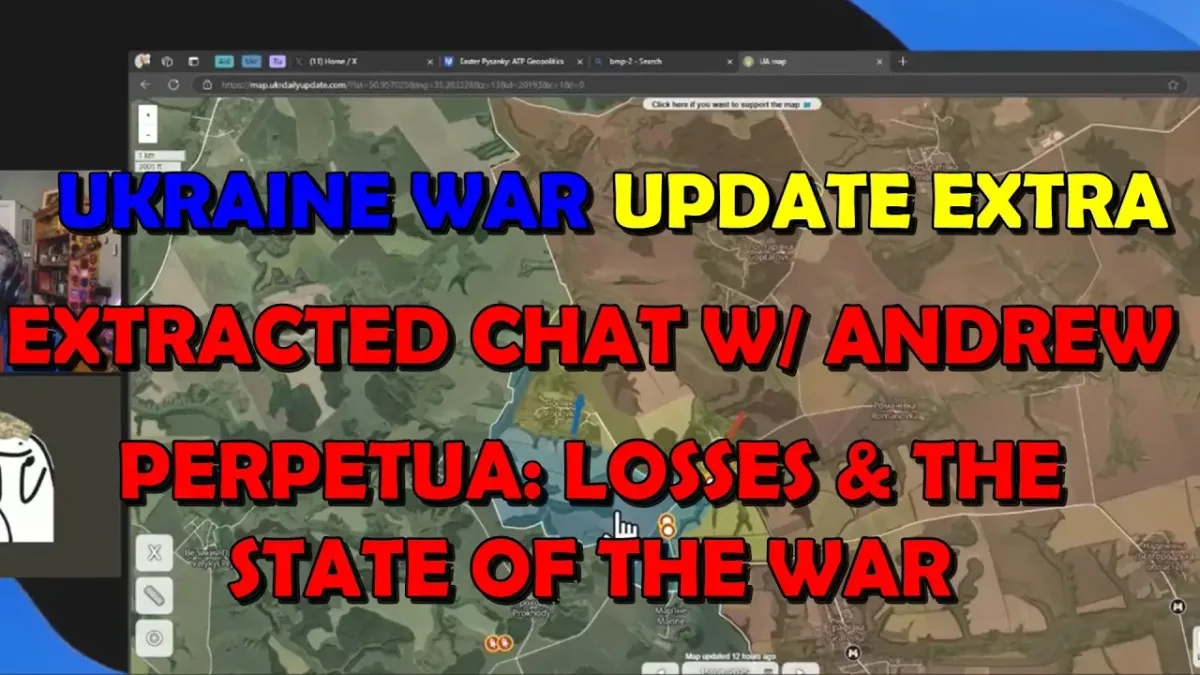
Extracted Chat w/ Andrew Perpetua: Losses & the State of the Ukraine War
Title:Extracted Chat w/ Andrew Perpetua: Losses & the State of the Ukraine War Topics:Hello Team, Andrew Perpetua on Interpreting Loss Data, Analysis of Recent Ukrainian Losses (Kursk/Sumy Focus), Clarification on 'Double Counting' Losses, Rubicon Drone Unit Operations & Losses (South Donetsk), Sign


🤖
This summary has been produced automatically by an AI Large Language Model (LLM) without any human intervention. Whilst every effort has been made to prompt the LLM to produce accurate output, there may be inconsistencies, inaccuracies or hallucinations!
Table of Contents 📖
"I don't think Putin understands what's going on in this war... Just like I don't think Trump understands what's going on. They live in these information bubbles where they are kind of immune from reality."
Hello Team
🎦 00:00-00:07⏩
- Jonathan introduces the segment, indicating it features Andrew Perpetua's interpretation of loss data previously discussed.
- He notes a second video covering sheets 11-19 will follow.
Andrew Perpetua on Interpreting Loss Data
🎦 00:17-00:50⏩
- Jonathan welcomes Andrew Perpetua.
- Jonathan mentions having reviewed Andrew's 19 sheets of loss data.
- He reiterates a point made earlier: classifying Russian losses is complex because non-standard vehicles (like civilian trucks) are often used as combat assets, potentially skewing simple combat asset loss counts.
Analysis of Recent Ukrainian Losses (Kursk/Sumy Focus)
🎦 00:50-03:56⏩
- Jonathan observes that Andrew's data shows significant Ukrainian kit losses recently, though not necessarily high-value items like the USV/UAV strike examples. Losses were mainly infantry mobility vehicles and similar items.
- He asks if this was mainly due to the Kursk Oblast incursion.
- Andrew confirms a lot of losses occurred in Kursk Oblast, but stresses they happened over time during the operation, not just during the withdrawal.
- Many Bradleys listed as lost were actually damaged or abandoned months prior (e.g., September) and only confirmed as lost later when Russian footage showed them still in place or destroyed.
- The Rubicon drone unit inflicted damage on the highway (Kursk/Sumy access route?), destroying a Bradley, 10-15 MRAPs, several Kirpis (which they seemed to target specifically), Humvees, and pickup trucks – mostly not 'super valuable' kit.
- Significant losses also occurred on a highway in Sumy Oblast (likely access route to Kursk Oblast), including MRAPs and M113s, in an area Russia subsequently captured (Andrew mentions near Basivka).
Clarification on 'Double Counting' Losses
🎦 03:56-04:45⏩
- Jonathan confirms his understanding, aligning with Andrew's explanation: losses appearing during withdrawal footage often represent accumulated damage/abandonments over months.
- He highlights that Andrew's spreadsheets correctly distinguish between 'damaged', 'abandoned', and 'destroyed' states, even if the same piece of equipment appears multiple times as its status changes (e.g., abandoned, then later hit by an IED and marked destroyed). This clarifies why loss numbers might seem inflated at first glance.
Rubicon Drone Unit Operations & Losses (South Donetsk)
🎦 04:45-05:54⏩
- Andrew notes further losses in Kharkiv and South Donetsk.
- The Rubicon drone unit also operated around Velyka Novosilka, attacking logistics routes north of the town.
- Their performance here was less impressive ("just a normal drone unit"), but they still destroyed Huskies, Bushmasters, Humvees, and a few Ukrainian Bohdana self-propelled howitzers.
Significance of Ukrainian-Produced Equipment Losses
🎦 05:54-06:24⏩
- Jonathan sees a "weird silver lining" in the loss of Ukrainian-produced equipment like Bohdanas and Novators.
- While losing kit is never good, it indicates that Ukraine's domestic production is increasing and supplying the front lines.
European/German Role in Ukrainian Equipment Production
🎦 06:24-08:26⏩
- Andrew adds that Europe, particularly Germany, is also producing equipment for Ukraine.
- He thinks Germany might be making chassis for Bohdanas and potentially other vehicles.
- This is partly driven by Germany's poor economic situation; truck manufacturers with low demand for civilian trucks have spare capacity and are seeking contracts, including from Ukraine.
- Andrew clarifies these are often deals between German companies and Ukraine, not necessarily direct German government initiatives (though funding routes can be complex via EU etc.).
- Jonathan connects this to a Spanish company (Technova) licensing Ukrainian vehicle designs (Medevac, MRAP).
Andrew's Assessment of Russian Forces' Condition
🎦 08:26-10:21⏩
- Jonathan asks Andrew for his overall assessment of the front line.
- Andrew states Russia is in "really a lot of trouble", and this is being underplayed.
- Infantry: Russia has large numbers, but morale is very low due to a culture of abuse ("treating people like trash").
- Equipment: Critically important for getting infantry to the right place/time. Russia is "largely out of armor". They likely have only 1,000-2,000 significant armoured vehicles left and low manufacturing rates (a few hundred/year).
- They are "really running out".
Russian Armour Refurbishment & Tactics
🎦 10:21-12:29⏩
- Andrew observes that Russian armour appears in batches, suggesting it's refurbished or repaired stock.
- He gives an example of a recent large attack near Chasiv Yar using upgraded BMP-2s (BMP-2M Berezhok / 675 SB3KDZ variant).
- He speculates these were likely damaged/destroyed hulls recovered from previous battles (e.g., Avdiivka), sent back to Russia, completely rebuilt/upgraded, and then deployed as a batch.
- Crucially, this entire batch was lost in the Chasiv Yar attack.
- This refurbishment effort isn't sufficient to replace losses; they can't manufacture or refurbish enough.
Ineffectiveness of Russian Light Vehicle Assaults
🎦 12:29-14:24⏩
- Andrew emphasizes that light vehicles (Ladas, UAZ 'loaves' etc.) cannot replace proper armour. They are useful only for surprise attacks.
- He cites a recent Russian attack near Verkhnokamyanske using ~13 light vehicles (Ladas etc.).
- Ukraine defended using DPICM cluster munitions (likely what "Depikim" refers to) and Automatic Grenade Launchers (AGS).
- The light vehicles couldn't withstand these weapons; everything was wiped out, possibly with no survivors, and the assault never even reached its objective.
- Andrew notes this is increasingly common: Russian assaults being destroyed before reaching the front line (mentions a humorous example from IMI geolocations). They lack the armoured punch to break through.
Role of Artillery vs. Drones in Defence
🎦 14:24-15:56⏩
- Jonathan asks about the relative importance of drones versus artillery.
- Andrew cites a comment, possibly from the 46th Airmobile Brigade, regarding a Russian attack in Andriivka.
- Ukraine reportedly repelled the attack using 600 artillery shells and 200 drones.
- The result: every piece of Russian armour and light vehicle was destroyed, and there were no Russian survivors.
- Jonathan notes this highlights artillery remains "pretty damn useful". Andrew points to the specific attack route ("that arrow there") on the map where this occurred.
Ukrainian Offensive Potential vs. Attritional Defence
🎦 15:56-19:23⏩
- Jonathan asks if Ukraine can still mount major offensives to retake significant land.
- Andrew argues Ukraine doesn't need to launch a major offensive.
- Instead, they should focus on wearing out the Russians through defence. Russia will eventually "leave on their own" because they lack the strength to defend passively.
- Passive defence for Russia means unsustainable casualties (tens of thousands/month), systematic destruction of defences, and eventual withdrawal.
- Russia cannot sustain the manpower losses from current attrition levels if they just sit passively ("5 or 10% chance to die every single day"). Morale would collapse.
- Holding defensively would require millions of men, which Russia doesn't have.
- Therefore, Russia must keep attacking (active offensive means) because passive defence is "effectively impossible" for them.
- Jonathan asks if Russia loses more attacking vs defending, suggesting Ukraine might prefer defending as it's more attritional for Russia. Andrew agrees attacking is generally worse, but stresses passive defence under current conditions (constant drone/artillery threat) is also highly costly and demoralising for Russia.
Situation Update: Belgorod/Kursk Border Incursions
🎦 19:23-21:46⏩
- Jonathan asks about the situation in Belgorod Oblast (misspoke as Belgrade).
- Andrew points to dots on the map (highway north of Popivka/Demidovka) representing Russia's main logistics route in the area being targeted.
- Ukrainian actions are cutting off Russian reinforcements and logistics.
- Russia is counter-attacking to retake lost ground (e.g., back in Demidovka, possibly contested Popivka), but facing heavy casualties and difficulties.
- Problems for Russia include:
- Destroyed bridges (Ukraine blew them up).
- Attempts to lay pontoons are being targeted by Ukraine.
- Few roads, many unpaved/farm tracks, making movement hard.
- Remote towns, requiring infantry to dismount far away and march.
Ukraine's Objective in Border Incursions
🎦 21:46-22:15⏩
- Jonathan asks about Ukraine's endgame in the border area.
- Andrew believes the primary goal was simply to create a buffer zone between Russia and Sumy Oblast.
- Ukraine would prefer fighting in Russian territory (like Popivka) than in Ukraine proper.
Russian Capability to Attack Sumy/Chernihiv
🎦 22:15-24:45⏩
- Jonathan asks if Russia has momentum to push further south from Kursk/Belgorod into Ukraine (Sumy).
- Andrew describes Sumy Oblast as very difficult terrain to attack: dense forests, few spindly roads through forests, strong Ukrainian trench systems. "A defender's dream".
- Russia might capture border regions but struggle deeper in.
- He notes Ukraine has warned about potential Russian attacks towards Chernihiv (as they have in previous years), but doubts Russia currently has the military capability for a successful large-scale offensive into Sumy or Chernihiv.
- Andrew states Ukraine genuinely believed Russia was going to attack Sumy, which prompted their own incursion into Kursk/Belgorod ("Sucha" mentioned here, unclear reference).
- He concludes Russia is "not successful doing much of anything anymore" and may not even have a coherent plan.
Putin's Endgame & Understanding of the War
🎦 24:45-28:06⏩
- Jonathan relays a viewer question (from Javier Alvarez) about Putin's endgame and whether he'll take a potential "Trump lifeline".
- Andrew believes Putin fundamentally misunderstands the war, living in an "information bubble" immune from reality, similar to Trump.
- He thinks Putin genuinely believes Ukraine is "on its last legs" and "one more push" will break them.
- Jonathan questions how Putin reconciles this belief with three years of failure. Andrew suggests Putin might lack tactical/operational awareness but must be frustrated.
- Andrew posits that the Russian military command structure perpetuates this bubble. Due to the culture of blame-shifting, commanders cover themselves by reporting successes (even declaring towns captured before attacking them) and forcing troops on futile "suicide missions" to fulfill unrealistic orders from above. This misinformation likely reaches Putin.
Russian Propaganda vs. Reality
🎦 28:06-29:39⏩
- Andrew suggests Russian propaganda likely reflects Putin's own distorted beliefs, aiming to create a narrative matching his worldview.
- Jonathan notes the higher-level question this raises: if Putin is brainwashed, who by? Suggests some in the military must recognise reality.
- Andrew counters that the blame-shifting culture means even those who see reality won't report it upwards accurately.
- The propaganda desperately tries to paint a false image of Russian power and imminent Ukrainian collapse, ignoring Russia's actual problems.
Russia's Dependence on Foreign Aid & Potential Levers
🎦 29:39-30:39⏩
- Andrew highlights Russia's severe problems:
- Economy is "trash".
- Running out of equipment.
- Completely dependent on foreign military aid (North Korea, Iran, etc.).
- He controversially suggests Russia might now be more dependent on foreign aid than Ukraine is.
- He believes the West could cripple Russia by leveraging relationships, particularly with China regarding North Korean aid.
US Secondary Sanctions & Trump's Impact
🎦 30:39-31:43⏩
- Jonathan agrees leverage exists, noting the Biden administration's Treasury Department (under Janet Yellen) was making progress with secondary sanctions.
- These sanctions were starting to impact banks and ports in India and China, discouraging transactions and handling of Russian oil. This required constant effort ("global whack-a-mole") but was having an effect.
- Andrew suggests this was a tool Trump could have used effectively.
- Instead, Trump started trade wars "with everyone", giving Russia "breathing room" and undermining the sanctions effort – something Jonathan finds infuriatingly counter-productive ("insanity").
Geopolitical Strategy: China, US & Europe
🎦 31:43-32:49⏩
- Andrew reiterates that the West has levers, particularly with China regarding North Korea, but lacks leaders willing to use them rationally (e.g., through negotiation with clear demands and mutual benefits). Current leaders seem to prefer "hoping for the best and doing nothing".
- Jonathan mentions Hungary as a disappointing factor in Europe.
Trump's Strategy Towards Europe
🎦 32:49-34:14⏩
- Andrew outlines what he sees as Trump's "pretty genius" (though destructive) strategy towards Europe:
- Effectively withdraw US support/engagement from Europe.
- Periodically offer false hope by calling/visiting European leaders and telling them what they want to hear.
- This dangling of hope paralyses Europe, preventing them from accepting the reality that the US relationship is fundamentally broken and acting decisively on their own.
- Andrew wishes Europe would recognise this tactic and break free from the "eternal hope that everything will go back to normal".
Europe's Potential & Need for Independence
🎦 34:14-35:38⏩
- Jonathan agrees Europe needs to "be done with the US" and act more assertively, like China.
- He heard analysis suggesting Europe holds cards against US trade actions but hasn't played them yet, preferring negotiation.
- He believes China is better positioned to win a trade war with the US (dictatorship can absorb more pain, holds leverage).
- Jonathan sees the outcome – Europe being torn from the US – as something Russia and China wanted, and Trump's actions are achieving it, even if it wasn't the broader US goal.
Andrew Perpetua's Workload & Increased Video Volume
🎦 35:38-36:44⏩
- Jonathan thanks Andrew for his time and appreciates his loss list work.
- Andrew confirms he is "insanely overworked".
- Since around January, his team's daily workload has doubled:
- From ~750 spreadsheet lines/day to ~1200-1300 lines/day.
- From ~160 videos processed/day to ~300 videos/day.
Reasons for Increased Video Content & Impact of Analysis
🎦 36:44-37:53⏩
- Jonathan asks why the volume has increased.
- Andrew speculates it's not necessarily more activity, but both sides releasing more footage.
- He thinks this is partly a reaction to analysis drawing attention to specific areas (e.g., Artem's articles on drone interceptions prompted both Ukraine and Russia to release more videos on that topic).
- "The more attention we bring to things... the more it gets posted of that thing."
Challenges of Analysing High-Volume/Poorly Edited Content
🎦 37:53-38:56⏩
- This feedback loop creates challenges. Andrew mentions they dislike practices like channels putting 100 events in a 90-second video because it's "very stressful" to analyse.
- He specifically names Robert Macchiato as an example, noting he now shows nine events simultaneously in tiles, making analysis incredibly difficult and "soul-destroying".
- They try not to draw attention to such channels to avoid encouraging these annoying editing practices.
Call for Help & Final Thoughts (Partial)
🎦 38:56-39:40⏩
- Jonathan asks if Andrew needs help.
- Andrew confirms they desperately need help with video analysis, but it requires people with specific skills and a huge commitment.
- He mentions there are "lesser things" people could potentially help with (transcript cuts off before details).
Wrap up
🎦 39:40-39:40⏩
- The extracted chat concludes here, mid-sentence, as Andrew was discussing the need for help with his analysis work.
🤖❓ AI Debrief (post task) - anything the AI didn't understand
The YouTube title "Extracted Chat w/ Andrew Perpetua: Losses & the State of the Ukraine War -" did not contain a date or part identifier in the standard YYYYMMDD(X) format. The `` and `` tags are therefore empty.
Place Name Clarifications:
"Chess of Yard" (11:18, 11:26) assumed to be Chasiv Yar.
"Belgrade" (19:28) assumed to be a slip of the tongue for Belgorod.
Unclear References:
"Sucha" (24:11) - Context suggests related to the Kursk/Belgorod incursion decision, but the specific place/meaning is unclear. Could be a typo or mishearing.
"Depikim" (13:11) - Assumed to be DPICM (Dual-Purpose Improved Conventional Munitions) based on context of use against light vehicles.
"Larders" (08:58) - Assumed to be Ladas (commonly used light vehicles by Russia).
"Party loaves" (08:58) - Likely refers to UAZ Bukhanka vehicles, often nicknamed 'loaf' (буханка) in Russian. The 'party' prefix is unclear - possibly a transcription error or slang?
The transcript ends abruptly at 39:40 while Andrew is speaking.
🤖💭 AI Plan (pre task) - the AI's step by step thought process
Identify Goal: Summarise the provided transcript of a chat between Jonathan MS Pearce (ATP Geopolitics) and Andrew Perpetua for the "ATP Distilled" project, following specific XML structure and content rules. Use British English.
Initial Scan & Context: Read through the transcript. It's a conversation focusing on equipment losses in the Ukraine war, Andrew Perpetua's data interpretation, the state of Russian forces, Ukrainian capabilities, border incursions, and broader geopolitical factors involving the US, Europe, and China. Jonathan asks questions, Andrew provides detailed analysis based on his loss tracking work.
TASK 1: Title, Date, Part:
Youtube Title: "Extracted Chat w/ Andrew Perpetua: Losses & the State of the Ukraine War -"
Title Extraction: "Extracted Chat w/ Andrew Perpetua: Losses & the State of the Ukraine War" (Remove trailing "-").
Date Extraction: The title format doesn't include a YYYYMMDD string. Note this as missing. Output empty tag or note missing. I will note it in queries and leave the tag empty for now.
Part Extraction: No part letter indicated. Output empty tag.
XML: `Extracted Chat w/ Andrew Perpetua: Losses & the State of the Ukraine War`, ``, ``.
TASK 2 & 3: Topic Titles & Timestamps: Segment the transcript and assign titles/timestamps.
Topic 1: Hello Team: Standard intro needed, even though transcript starts mid-flow. Timestamp 00:00 (start of transcript).
Topic 2: Andrew Perpetua on Interpreting Loss Data: Jonathan introduces Andrew and discusses the complexity of interpreting loss data, mentioning Andrew's 19 sheets. Timestamp 00:00-00:50⏩. (Initial intro part from transcript)
Topic 3: Analysis of Recent Ukrainian Losses (Kursk/Sumy Focus): Discussion about recent Ukrainian losses, particularly infantry mobility vehicles, MRAPs, M113s, Bradleys, Kirpys, Humvees, pickup trucks, linked to Kursk and Sumy border operations. Andrew explains many weren't lost during withdrawal but damaged/abandoned earlier. Timestamp 00:50-03:56⏩. (Covers Andrew's detailed explanation of where/when losses occurred).
Topic 4: Clarification on 'Double Counting' Losses: Jonathan confirms understanding of how damaged/abandoned equipment is later recorded as destroyed, appearing multiple times but correctly documented by Andrew. Timestamp 03:56-04:45⏩.
Topic 5: Rubicon Drone Unit Operations & Losses: Andrew details losses inflicted by the Rubicon unit in Kharkiv, South Donetsk (Velyka Novosilka area), targeting logistics routes. Mentions Huskies, Bushmasters, Humvees, Bohdanas hit. Timestamp 04:45-05:54⏩.
Topic 6: Significance of Ukrainian-Produced Equipment Losses: Jonathan notes the appearance of Ukrainian equipment (Bohdanas, Novators) in loss lists signifies increased domestic production. Timestamp 05:54-06:24⏩.
Topic 7: European/German Role in Ukrainian Equipment Production: Andrew mentions Germany producing equipment/chassis (e.g., for Bohdanas) for Ukraine, driven partly by German economic conditions (truck manufacturers seeking work). Jonathan links this to Spain licensing Ukrainian designs. Timestamp 06:24-08:26⏩.
Topic 8: Andrew's Assessment of Russian Forces' Condition: Jonathan asks for Andrew's view. Andrew states Russia is in "a lot of trouble", underplayed by many. Good infantry numbers but low morale (due to culture), critically low on armour/equipment. Timestamp 08:26-10:21⏩.
Topic 9: Russian Armour Refurbishment & Tactics: Andrew describes how Russia refurbishes damaged/destroyed vehicles (e.g., BMP-2s) in batches, sends them to the front (e.g., Chasiv Yar), where they are quickly lost. Timestamp 10:21-12:29⏩.
Topic 10: Ineffectiveness of Russian Light Vehicle Assaults: Russia substituting armour with light vehicles (Ladas etc.) which are ineffective against prepared defences (e.g., near Verkhnokamyanske, attack wiped out by DPICM/AGS). Many assaults fail before reaching the front line. Timestamp 12:29-14:24⏩.
Topic 11: Role of Artillery vs. Drones in Defence: Jonathan asks about drones vs artillery. Andrew cites a 46th Brigade report from Andriivka: attack repelled with 600 artillery shells and 200 drones, destroying all Russian equipment, no survivors. Shows artillery remains crucial. Timestamp 14:24-15:56⏩.
Topic 12: Ukrainian Offensive Potential vs. Attritional Defence: Jonathan asks about Ukraine's ability to launch major offensives. Andrew argues Ukraine doesn't need a major offensive; wearing Russia down through attritional defence is more effective as Russia cannot sustain defensive losses/morale collapse. Timestamp 15:56-19:23⏩.
Topic 13: Situation Update: Belgorod/Kursk Border Incursions: Jonathan asks about Belgorod (misspoken as Belgrade). Andrew points to map, showing Ukrainian forces targeting Russia's main logistics highway, cutting off reinforcements. Russia counter-attacking (e.g., towards Demidovka) with difficulty due to destroyed bridges, pontoons being hit, terrain (few paved roads, remote towns). Timestamp 19:23-21:46⏩.
Topic 14: Ukraine's Objective in Border Incursions: Andrew states Ukraine aimed to create a buffer zone (e.g., fighting in Popivka rather than Sumy Oblast). Timestamp 21:46-22:15⏩.
Topic 15: Russian Capability to Attack Sumy/Chernihiv: Jonathan asks about Russian momentum. Andrew assesses Sumy as very difficult terrain for attackers (forests, few roads, defences). Doubts Russia has the capability for a successful major attack there or in Chernihiv, despite Ukrainian warnings. Timestamp 22:15-24:45⏩.
Topic 16: Putin's Endgame & Understanding of the War: Responding to viewer Javier Alvarez, Andrew believes Putin (and Trump) lives in an information bubble, doesn't grasp reality, believes Ukraine is near collapse, and is fed misinformation by military command structure focused on blame-shifting. Timestamp 24:45-28:06⏩.
Topic 17: Russian Propaganda vs. Reality: Andrew suggests Russian propaganda reflects Putin's own distorted view. Jonathan notes the disconnect between this view and the lack of progress. Timestamp 28:06-29:39⏩.
Topic 18: Russia's Dependence on Foreign Aid & Potential Levers: Andrew highlights Russia's reliance on aid (North Korea, Iran etc.), suggesting Russia is now more dependent than Ukraine. Discusses potential for Western leverage via China/North Korea, hampered by lack of rational leadership/strategy. Timestamp 29:39-30:39⏩.
Topic 19: US Secondary Sanctions & Trump's Impact: Jonathan notes the Biden administration's Treasury Dept was having success with secondary sanctions (hitting banks/ports dealing with Russia) before Trump's actions undermined this and started trade wars, inadvertently helping Russia. Timestamp 30:39-31:43⏩.
Topic 20: Geopolitical Strategy: China, US & Europe: Andrew reiterates the potential to use rational diplomacy/demands with China to curb support for Russia (e.g., North Korea). Criticises current Western leaders for inaction. Jonathan agrees, noting US/Trump actions are pushing Europe away, which ironically suits Russia/China. Timestamp 31:43-32:49⏩.
Topic 21: Trump's Strategy Towards Europe: Andrew describes Trump's tactic: withdrawing US support while occasionally offering false hope to European leaders, paralyzing them and preventing them from accepting the changed relationship and acting independently. Timestamp 32:49-34:14⏩.
Topic 22: Europe's Potential & Need for Independence: Jonathan agrees Europe needs to act independently, has cards to play against US trade actions, and notes China is better positioned to win a trade war against the US. Both lament the current situation. Timestamp 34:14-35:38⏩.
Topic 23: Andrew Perpetua's Workload & Increased Video Volume: Jonathan thanks Andrew. Andrew explains his team's workload has doubled (750 to 1200-1300 lines/day, 160 to 300 videos/day) since January. Timestamp 35:38-36:44⏩.
Topic 24: Reasons for Increased Video Content & Impact of Analysis: Andrew speculates the increased volume is partly a reaction to analysis (like his team's or Artem's articles on drone interceptions), prompting both sides to release more footage to prove their capabilities. Timestamp 36:44-37:53⏩.
Topic 25: Challenges of Analysing High-Volume/Poorly Edited Content: Andrew mentions difficulties with channels releasing huge amounts of data in short, poorly edited videos (mentions Robert Macchiato showing 9 events tiled at once), making analysis stressful and "soul-destroying". Timestamp 37:53-38:56⏩.
Topic 26: Call for Help & Final Thoughts (Partial): Jonathan asks if Andrew needs help. Andrew confirms help is needed but requires specific skills and commitment. Mentions lesser tasks exist. Transcript cuts off. Timestamp 38:56-39:40⏩ (end of transcript).
Topic 27: Wrap up: Standard closing. Timestamp 39:40 (use end timestamp).
TASK 4: Topic Summaries: Write summaries for each topic, incorporating details, names, corrections (Chasiv Yar, Belgorod, Sumy, Velyka Novosilka, Andriivka, Verkhnokamyanske, Bohdana, DPICM, Lada), and insights from both speakers. Use markdown.
TASK 5: Quote: Select a quote. Andrew's assessment of Russia's state seems significant: "Well, the Russians are in really a lot of trouble right now. People are really underplaying how much trouble they're in." or his point about defence: "What they [Ukraine] need to do is wear out the Russians, and the Russians will leave on their own. They don't have the strength to defend." The quote about Putin/Trump living in information bubbles is also strong: "I don't think Putin understands what's going on in this war... Just like I don't think Trump understands what's going on. They live in these information bubbles where they are kind of immune from reality." Let's use the Putin/Trump one for its broader geopolitical insight.
TASK 6: Queries: Note the missing date/part info. Clarify "Chess of Yard" (assumed Chasiv Yar), "Belgrade" (assumed Belgorod), "Sucha" (unclear). "Depikim" (assumed DPICM), "Larders" (assumed Ladas), "Party loaves" (likely UAZ Bukhanka 'loaves'). Note the abrupt end of the transcript.
Final Review: Check all XML tags, structure, content rules, British English, spelling corrections, clarity, and flow. Ensure closing tags match opening tags precisely.
🤖💭 AI Plan (pre task) - the AI's step by step thought process
The user wants me to summarise a YouTube transcript featuring Jonathan MS Pearce (ATP Geopolitics) interviewing Andrew Perpetua.
The output must be in British English, follow a specific XML structure, and capture key insights about the Russia-Ukraine war, equipment losses, force assessments, and geopolitical factors.
Plan:
Parse the request and understand all constraints and tasks.
Read the transcript carefully to grasp the conversation's content and nuances.
Task 1: Extract the title, identify the missing date and part from the provided YouTube title.
Task 2: Define topic titles. Start with "Hello Team", segment the conversation logically based on subject changes, ensuring titles are specific and granular. Correct place names (Kursk, Sumy, Chasiv Yar, Belgorod, Velyka Novosilka, Andriivka, Verkhnokamyanske) and potentially misheard terms. End with "Wrap up".
Task 3: Assign start and end timestamps from the transcript to each topic title. Ensure full coverage.
Task 4: Write a bullet-point summary for each topic, capturing the core information, analysis from both Jonathan and Andrew, correcting spellings, and using British English.
Task 5: Select a poignant or insightful quote from the transcript.
Task 6: Document any uncertainties or missing information (e.g., missing date, unclear terms like "Sucha", "party loaves").
Assemble the final response in the specified XML format, double-checking all tags and structure.