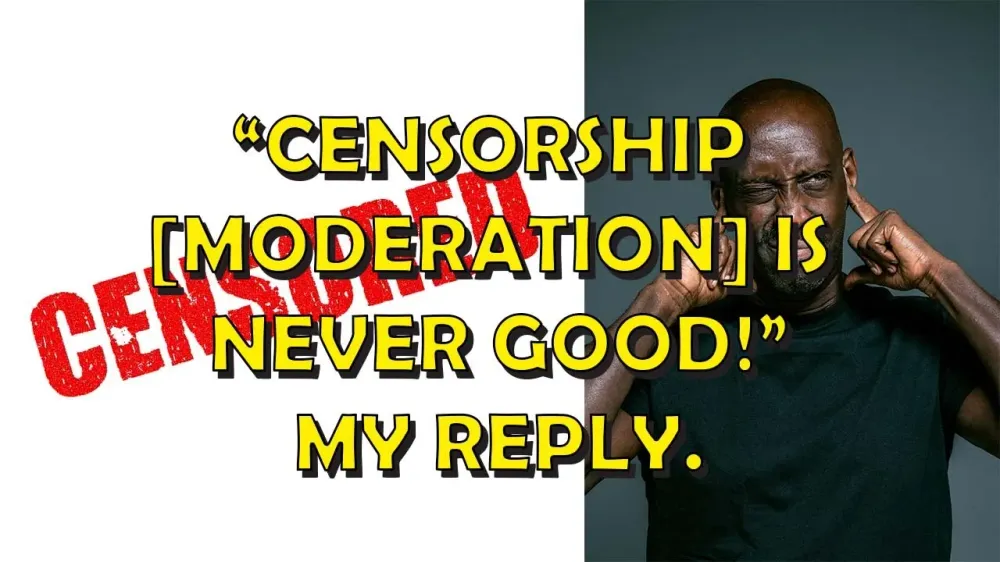
Censorship Is Never Good! A Reply.
🤖
This summary has been produced automatically by an AI Large Language Model (LLM) without any human intervention. Whilst every effort has been made to prompt the LLM to produce accurate output, there may be inconsistencies, inaccuracies or hallucinations!
Table of Contents 📖
| Topic ID | Topic Title | Timestamp |
|---|
"Moderation is just and and censorship has many different aspects. And in many ways, it's absolutely necessary to have the kind of functioning societies that we have."
Hello Team!
Jonathan responds to comments on a previous video about Twitter, disinformation and moderation. Some viewers misinterpreted his views as advocating for censorship. Jonathan aims to clarify his position.
Return to top⤴️
Responding to viewer comments
- One commenter said "censorship is never good" and people should control what their children see rather than censoring content. Jonathan strongly disagrees with this extreme view.
- Another commenter accused Jonathan of being a "censorship Nazi". Jonathan explains he is trying to be nuanced, not extreme.
- A commenter said they had to unsubscribe because Jonathan "advocated for the censorship that's been used by the corrupt." Jonathan notes this commenter is actually censoring himself by refusing to hear other views.
The importance of content moderation
- Jonathan plays a clip from an interview with the editor-in-chief of The Verge discussing how content moderation is essential for social media platforms to provide a good user experience and be financially viable.
- Platforms moderate content through rules and by incentivizing the content they want. The product a social network makes is content moderation.
- Without moderation, platforms would be overrun with offensive content and most users and advertisers would leave. There is a tension between free speech and making money.
Nuance in the free speech debate
- Jonathan argues there are competing rights at play - the right to free speech vs the right not to hear offensive things. Where we draw the line is subjective.
- An extreme free speech position is untenable and would undermine things like intellectual property and copyright which are widely accepted.
- Context matters - different platforms can have different standards based on their audience and purpose. Moderation is about curating spaces to provide a positive experience.
- Jonathan himself allows a lot of free speech in his comment sections but still moderates to maintain a constructive dialogue. He was previously criticized for being too lax.
Wrap up
Jonathan encourages viewers to have constructive conversations about disagreements rather than unsubscribing or throwing around accusations. He provides links to additional content he has written on the topic of free speech and content moderation. He asks viewers to like, subscribe and share or provide thoughtful feedback if they disagree.
Return to top⤴️
🤖❓ AI Debrief (post task) - anything the AI didn't understand
The transcript was clear and I did not have any issues understanding the content.
🤖💭 AI Plan (pre task) - the AI's step by step thought process
Steps:
Read through the transcript to get an overall sense of the content and topics covered
Identify the main topics and points made in the order they appear
Summarize each topic concisely, capturing the key points and Jonathan's perspective
Use the provided XML structure to organize the summary
Include an introduction and wrap-up section
Select a key quote that captures the essence of the video
Review and refine the summary, checking it aligns with the transcript