Ben Hodges on the War
Table of Contents 📖
| Topic ID | Topic Title | Timestamp |
|---|
"If my president, and I have not only great respect for my president, but also he's done a good job and you've got 50 nations sticking together, not just NATO nations, continuing to support Ukraine..."
Hello Team!
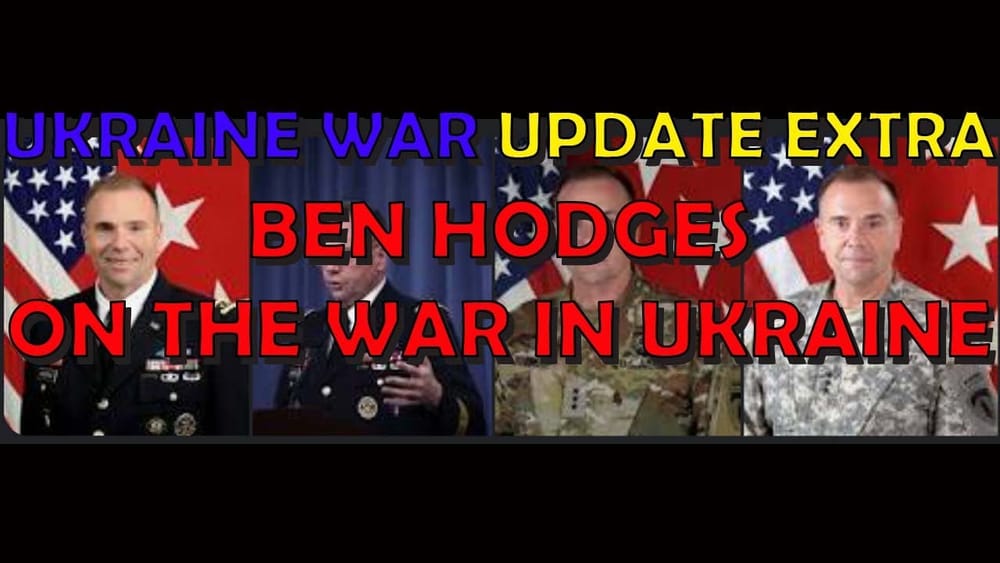
Jonathan introduces the video, which will focus on the opinions of Ben Hodges, a retired United States Army officer who served as commanding general for the United States Army Europe. Hodges is a significant military mind and his analysis of the Ukraine war is valuable. He was in charge during the 2014 Crimea annexation.
Return to top⤴️
Hodges on Crimea and Russian military leadership
Hodges has talked about the importance of taking Crimea, which is crucial to the outcome of the war and the future of Ukraine. He believes it is a doable and primary objective for the Ukrainians. Hodges also discusses the friction and hatred within the Russian military leadership, comparing it to ancient Rome. This lack of cohesion and trust trickles down to the troops and has a debilitating effect on their combat strength and ability to form a coherent defensive strategy.
Return to top⤴️
Centre of gravity concept
The concept of centre of gravity, introduced by Clausewitz, refers to the thing that gives one side its power, whether tangible (e.g. land force, navy) or intangible (e.g. popular support, industrial power). For Russia, their centre of gravity is mass - mass infantry, artillery, and a willingness to spend it. Politically, Putin is their centre of gravity as a total autocrat. However, it's unclear who influences him or how insulated he is from information.
Return to top⤴️
Conditions for Ukrainian counteroffensive
General Zaluzhny, the chief of the Ukrainian general staff, is an impressive soldier. Hodges believes there are three conditions for the counteroffensive:
- Ukrainian forces being ready with enough strength and armoured brigades.
- Russian forces being degraded enough to give the best chance of success.
- The ground being dry enough to support the movement of heavy armoured vehicles.
When these conditions are met, the counteroffensive will likely involve combined arms (mechanised infantry, tanks, engineers, artillery, air defence) concentrated on narrow fronts to penetrate Russian defences. There will likely be two or three main efforts and a couple of decoy/supporting attacks.
Return to top⤴️
Potential for Russian collapse
Hodges believes there is a real potential for Russian defences to crack open if Ukrainian forces manage to bypass or get behind them, as many Russian soldiers in the trenches are poorly trained and undisciplined. If they hear the enemy is behind them, they may panic and break. The lack of cohesion and resentment towards commanders in the Russian forces, compared to the Ukrainians fighting for their homeland, friends and families, could lead to a collapse.
Return to top⤴️
What's at stake in the war
Hodges emphasises that American security depends on European security and prosperity, which requires a stable Europe. The war is about upholding the international rules-based order, including respect for borders, sovereignty, freedom of navigation, human rights, and international agreements - all things Russia hates but are important for the US and its allies. China is watching to see if the West is willing to defend these values. If not, the chance of China making a miscalculation like Russia did with Taiwan or the South China Sea increases. Hodges believes what happens in Ukraine will determine future relationships with China.
Return to top⤴️
Lessons and the future
The biggest lesson, according to Hodges, is that you can't appease a brutal autocracy like Russia. They only respect strength. Russia has been an empire for almost five centuries, and until they are defeated on the battlefield, there will never be a reckoning. Whoever comes after Putin will be similar, just with a less effective military. Russia made their miscalculations based on overconfidence and the perception that the West, particularly the US, was in disarray (e.g. after the 2020 election, January 6th, Afghanistan withdrawal). Germany was also still building Nord Stream 2 in late 2021. The lack of robust response to previous Russian actions in Georgia, Chechnya, and Crimea also contributed to their decision to invade.
Return to top⤴️
Wrap up
Jonathan thanks his supporters on Buy Me a Coffee and says he has a long list of topics for future extra videos. He appreciates all the wonderful support and will speak to viewers again soon.
Return to top⤴️