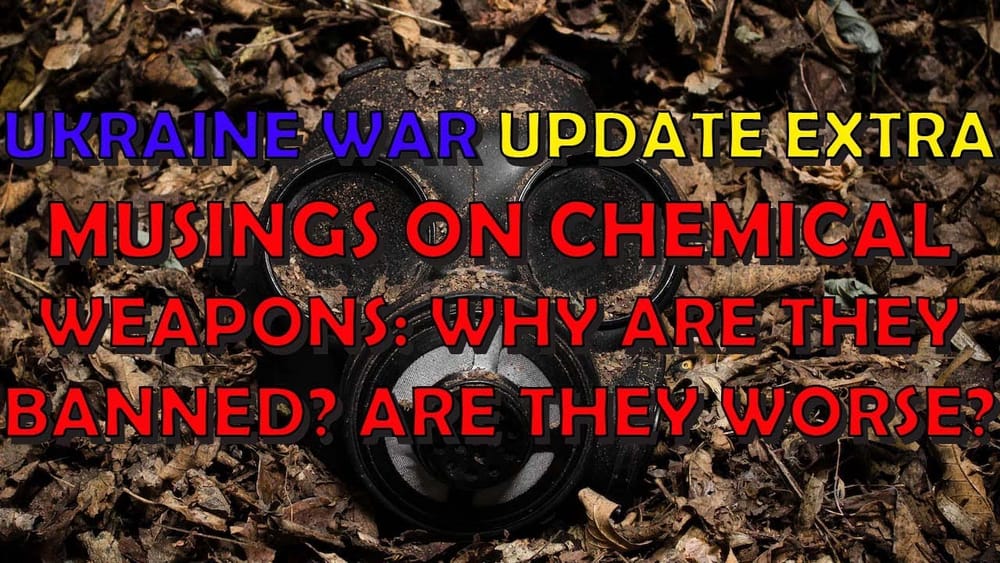
Chemical Weapons: Why Are They Banned? Are They Any Worse?
Table of Contents 📖
| Topic ID | Topic Title | Timestamp |
|---|
"The world's militaries don't want to ban weapons that are efficient killers."
Hello Team!
Jonathan introduces the topic of chemical weapons and why they are banned. He questions whether there is a meaningful philosophical distinction between the horror of chemical weapons versus conventional weapons. Jonathan references a previous video where he discussed the use of tear gas by Russia against Ukraine.
Return to top⤴️
Viewer Comments on Chemical Weapons
Jonathan reads out and responds to several viewer comments from a previous video regarding why chemical weapons like tear gas are banned:
- Chemical weapons are banned because they are used to kill and cause irreparable damage
- Chemical weapons make it easier to kill troops who are disoriented and unable to defend themselves
- Tear gas is banned because it is a "mask breaker" that can be combined with lethal agents
- Banning tear gas prevents escalation to worse chemical weapons
Jonathan questions the arguments, pointing out inconsistencies and comparing the effects to conventional weapons. He invites respectful discussion and debate on the topic.
Return to top⤴️
Why Chemical Weapons Are Banned
Referencing a Politico article, Jonathan outlines key reasons chemical weapons are banned:
- They are militarily ineffective compared to conventional weapons. Historically, countermeasures were quickly developed.
- They are difficult to control and can harm one's own troops.
- There is a stigma against their use as being too horrific, though Jonathan questions this.
- Many countries agreed to ban them because they did not have them or need them.
Jonathan argues that the true reasons for banning chemical weapons may be more practical than moral. He suggests they were banned because they were not effective enough to be worth keeping.
Return to top⤴️
The Sorites Paradox and Defining Boundaries
Jonathan explains the philosophical concept of the Sorites Paradox, which questions how we draw lines and boundaries along a continuum. Examples include:
- When does a collection of sand grains become a heap?
- At what point in evolution does one species become another?
- What distinguishes a horrific weapon from an acceptable one?
He argues it is difficult and somewhat arbitrary to demarcate a clear line between what is banned or allowed in warfare. The same paradox applies to concepts like adulthood that vary across time and culture.
Return to top⤴️
Questioning Intuitions About Chemical Weapons
Jonathan challenges intuitive revulsions people have to chemical weapons, arguing that conventional weapons can be just as horrific and destructive, if not more so. He provides examples like thermobaric munitions that burn victims. Jonathan clarifies that he is not justifying chemical weapons, but rather questioning the consistency of our moral intuitions. He invites the audience to think critically about the topic.
Return to top⤴️
Wrap up
Jonathan concludes by reiterating that while chemical weapons are disgusting and horrific, so are many conventional weapons. He questions whether there is a meaningful moral difference between the two, or if chemical weapons were primarily banned for practical reasons of ineffectiveness, while still being stigmatized as uniquely abhorrent. Jonathan encourages his viewers to question everything, including their own intuitions, and to continue the discussion respectfully.
Return to top⤴️