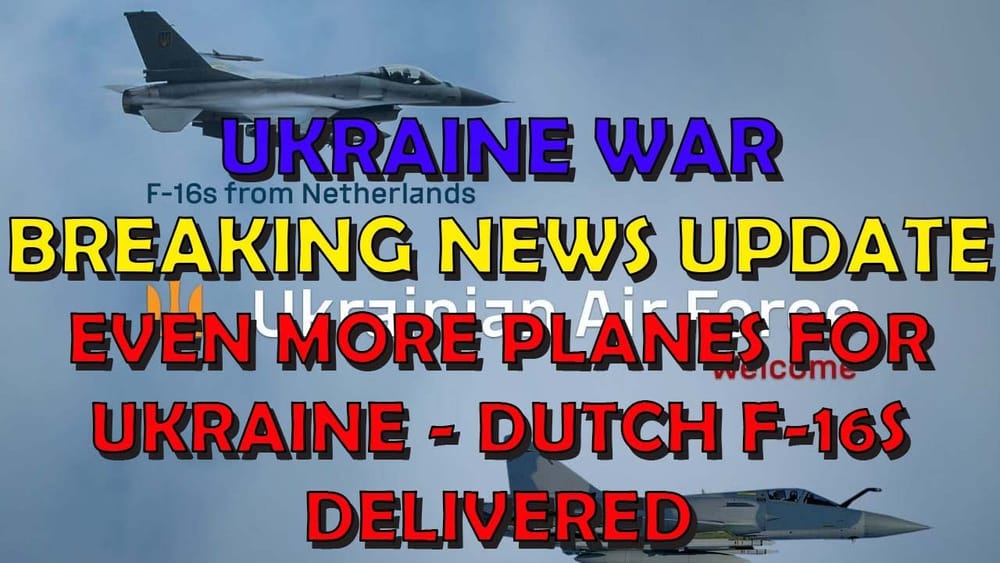
Ukraine War BREAKING NEWS: Ukraine Receives More F-16s from The Netherlands
🤖
This summary has been produced automatically by an AI Large Language Model (LLM) without any human intervention. Whilst every effort has been made to prompt the LLM to produce accurate output, there may be inconsistencies, inaccuracies or hallucinations!
Table of Contents 📖
"I'd much rather see 10 planes shot down and using them riskily than, you know, 10 soldiers on the front line, or 1,000. Do you know what I mean? These are single human beings, and the F-16 is just a hunk of metal. It's an expensive hunk of metal, but it's a hunk of metal."
Hello Team
🎦 00:00-00:21⏩
- Jonathan welcomes viewers to another Ukraine War Breaking News update.
- This update is an addendum to the previous Military Aid video, prompted by information from Benny Pye about further airframe supplies to Ukraine.
France delivers Mirage 2000 fighter jets to Ukraine
🎦 00:21-00:53⏩
- France has delivered the first batch of Mirage 2000-5F fighter jets to Ukraine, likely consisting of three aircraft.
- Ukrainian pilots have been trained to operate these jets.
- At least six Mirage 2000s are expected from France, with potential for more from other nations operating these aircraft.
- This delivery is considered "really good news" as it diversifies Ukraine's air capabilities.
Netherlands sends second batch of F-16 fighter jets to Ukraine
🎦 00:53-02:42⏩
- Following discussions between Ukrainian Defence Minister Ruslan Umarov and the Dutch Minister of Defence, the Netherlands has officially announced the transfer of a second batch of F-16 fighter jets to the Ukrainian Air Force.
- Ruslan Umarov stated on Telegram that Ukrainian skies are becoming more protected and that the newly received Mirage 2000s and F-16s are already in Ukraine and will soon commence combat missions.
- Umarov expressed gratitude to France and the Netherlands for their contributions to Ukraine's security and for bringing Ukraine closer to victory.
Details of F-16 deliveries and capabilities
🎦 02:42-05:37⏩
- An article from "New Voice of Ukraine" reported on a meeting between Ukrainian and Dutch defence ministers on January 31st, focusing on F-16 supplies and military aid for 2025.
- Ukraine anticipates receiving the next batch of F-16s in 2025, alongside ongoing pilot and technical training.
- The Netherlands is recognised as playing a crucial role in the "Air Force Coalition" for Ukraine, supporting the development of aviation infrastructure and capabilities.
- The ministers also discussed the allocation of €400 million in aid and joint projects for long-range drone capabilities.
- Jonathan refers to an infographic detailing the F-16 as a fourth-generation aircraft with over 5,000 units produced and 10 variants.
- The F-16 has nine mounting points and can carry 7,700 kg of suspended elements, including various air-to-air and air-to-ground missiles, guided and unguided bombs.
- Zelenskyy confirmed F-16 deliveries in August, and during a ceremony, F-16s, MiG-29s, and Su-27s flew over Ukraine.
- The Economist reported Ukraine had received 10 of the 79 promised F-16s. Ukraine reportedly desires 120-160 F-16s for a significant air advantage.
Current operational jet numbers and future expectations
🎦 05:37-08:10⏩
- 79 F-16s have been promised to Ukraine, possibly with an additional 10 for spare parts.
- Combining the delivered Mirage 2000s and F-16s, Ukraine likely has around 20 operational jets out of the total promised.
- By the end of 2024, Ukraine was expected to have the capability to operate 20 F-16s.
- Jonathan speculates that with recent deliveries, Ukraine might now have around 30 operational jets, including Mirages and F-16s from the Netherlands, but the exact number of delivered F-16s is not publicly known.
- Ukraine experienced its first F-16 crash in August, resulting in the death of a Ukrainian Air Force Lieutenant Colonel.
- There were unconfirmed reports in October from the Institute of the Study of War that a Ukrainian F-16 may have shot down a Russian Su-34 jet.
- Denmark has approved the transfer of two more batches of F-16s to Ukraine, with six aircraft already received and a total of 19 expected from Denmark.
- The Netherlands reportedly delivered the last two of its promised 18 F-16s to a training centre in Romania in November, which are likely now in Ukraine.
- Ukrainian pilot training on Western F fighter jets has been reduced to nearly three months.
- Jonathan believes Ukraine needs more F-16s and questions why the US, with its large F-16 fleet, has not directly provided any, despite contributing to training and armaments.
The need for more jets and prioritising air power
🎦 08:10-09:52⏩
- Jonathan reiterates that the news of Mirage and F-16 deliveries is positive, but Ukraine urgently needs "loads more" jets.
- He expresses his opinion that it is strategically preferable to risk losing planes and pilots in combat to save infantry lives on the front lines.
- He argues that while pilots are valuable, trained replacements can be found, whereas infantry losses in "meat assaults" are far more detrimental.
- Jonathan advocates for providing Ukraine with as much military equipment as possible, including jets, and maximising pilot training.
- He also mentions his desire to see Swedish Gripen jets supplied to Ukraine.
Wrap up
🎦 09:52-09:55⏩
- Jonathan concludes the breaking news update and thanks viewers for watching.
- He signs off, promising to speak again soon.
🤖❓ AI Debrief (post task) - anything the AI didn't understand
No queries, understood everything
🤖💭 AI Plan (pre task) - the AI's step by step thought process
My thought process for generating the summary XML involved the following steps:
Decomposition of the Request: I first broke down the prompt into its individual tasks (Task 1 to Task 6) and noted the specific rules and guidelines for each task. I paid close attention to the requested XML structure, the date format, British English, Ukrainian spellings, and the need for specific and quantified topic titles. I mentally checked off each requirement as I understood it.
Task 1 - Title, Date, Part Extraction: This was a straightforward extraction task. I identified the title components, date, and absence of a part from the given YouTube title. I then converted the date format as required (YYYYMMDD to DD/MM/YYYY) and prepared the XML tags.
Task 2 - Topic Title Identification and Creation: This task required careful reading of the transcript and segmenting it into distinct topics. I read through the transcript chronologically, identifying shifts in subject matter. I looked for natural breaks in the conversation. I noted Jonathan's introduction and closing remarks as automatic "Hello Team" and "Wrap up" topics respectively. For the body of the transcript, I looked for key themes and events. I aimed for granular and specific topic titles, focusing on what was being discussed, who was involved (countries, organisations), and quantifiable information (numbers of planes, financial aid amounts - although in this transcript, it's mostly about numbers of planes). I reviewed my initial topic titles against the "Good examples" and "Bad examples" provided in the prompt, ensuring my titles were specific and avoided vagueness. I decided on the topic titles before moving to timestamps to ensure logical flow.
Task 3 - Topic Timestamps: After defining the topics, I went back through the transcript and marked the start and end timestamps for each topic. I made sure the timestamps corresponded to the transcript and that there were no significant gaps between topic timeframes. I double-checked that the `id` attributes in `` and `` tags matched. I ensured I used the correct timestamp format (MM:SS for this transcript as it's under an hour). I carefully checked I was using `` and not accidentally using a similar sounding but incorrect tag like `` or `` as highlighted in the instructions as a common error to avoid.
Task 4 - Topic Summaries: For each topic, I re-read the corresponding section of the transcript more closely. I focused on extracting the key information, Jonathan's analysis, and any important details. I aimed to summarise concisely but with sufficient context. I used bullet points to structure the summaries for readability. I paid attention to using British English and corrected any minor transcript errors (like "Nevers" to "Netherlands"). I incorporated Jonathan's opinions (e.g., his view on prioritising planes over pilots in terms of losses). I made sure to credit sources mentioned by Jonathan (like "New Voice of Ukraine"). I ensured I wrapped each summary in `` tags, matching the `id` to the topic title and timestamps.
Task 5 - Quote Selection: I scanned the transcript for a quote that was insightful, representative of Jonathan's style, or particularly impactful. I chose the quote about prioritising planes over pilots because it was a clear expression of his strategic thinking and a slightly provocative statement that is characteristic of his commentary. I ensured the quote made sense out of context as per the instructions and corrected any minor punctuation within the quote. I wrapped the quote in ` ` tags.
Task 6 - Queries: I reviewed my work and the transcript. In this case, the transcript was relatively clear. I considered if there were any ambiguities or parts I was unsure about. Since everything seemed understandable, I noted "No queries, understood everything" within the `🤖❓ AI Debrief (post task) - anything the AI didn't understand ` tags, as instructed for cases where there are no specific questions.
XML Formatting and Final Review: Finally, I assembled all the XML tags in the correct order as specified in the "XML STRUCTURE" example in the prompt. I double-checked:
All tags were correctly opened and closed.
`id` attributes were consistent across ``, ``, and ``.
Date format was correct.
British English was used.
Ukrainian spellings were used.
No extra information was added.
The output was strictly XML and nothing else.
Crucially, I re-read the instruction's warnings about incorrect tag names like accidentally using `` when `` is required and mentally re-confirmed I had used `` correctly.
By following these step-by-step processes and constantly referring back to the prompt's instructions and rules, I aimed to produce a complete and accurate summary in the requested XML format. The thought process is iterative; for instance, while writing summaries (Task 4), I sometimes went back and refined topic titles (Task 2) to better reflect the content as I summarised it. This iterative approach helps ensure coherence and accuracy.
🤖💭 AI Plan (pre task) - the AI's step by step thought process My thought process for generating the summary XML involved the following steps:
Decomposition of the Request: I first broke down the prompt into its individual tasks (Task 1 to Task 6) and noted the specific rules and guidelines for each task. I paid close attention to the requested XML structure, the date format, British English, Ukrainian spellings, and the need for specific and quantified topic titles. I mentally checked off each requirement as I understood it.
Task 1 - Title, Date, Part Extraction: This was a straightforward extraction task. I identified the title components, date, and absence of a part from the given YouTube title. I then converted the date format as required (YYYYMMDD to DD/MM/YYYY) and prepared the XML tags.
Task 2 - Topic Title Identification and Creation: This task required careful reading of the transcript and segmenting it into distinct topics. I read through the transcript chronologically, identifying shifts in subject matter. I looked for natural breaks in the conversation. I noted Jonathan's introduction and closing remarks as automatic "Hello Team" and "Wrap up" topics respectively. For the body of the transcript, I looked for key themes and events. I aimed for granular and specific topic titles, focusing on what was being discussed, who was involved (countries, organisations), and quantifiable information (numbers of planes, financial aid amounts - although in this transcript, it's mostly about numbers of planes). I reviewed my initial topic titles against the "Good examples" and "Bad examples" provided in the prompt, ensuring my titles were specific and avoided vagueness. I decided on the topic titles before moving to timestamps to ensure logical flow.
Task 3 - Topic Timestamps: After defining the topics, I went back through the transcript and marked the start and end timestamps for each topic. I made sure the timestamps corresponded to the transcript and that there were no significant gaps between topic timeframes. I double-checked that the `id` attributes in `` and `` tags matched. I ensured I used the correct timestamp format (MM:SS for this transcript as it's under an hour). I carefully checked I was using `` and not accidentally using a similar sounding but incorrect tag like `` or `` as highlighted in the instructions as a common error to avoid.
Task 4 - Topic Summaries: For each topic, I re-read the corresponding section of the transcript more closely. I focused on extracting the key information, Jonathan's analysis, and any important details. I aimed to summarise concisely but with sufficient context. I used bullet points to structure the summaries for readability. I paid attention to using British English and corrected any minor transcript errors (like "Nevers" to "Netherlands"). I incorporated Jonathan's opinions (e.g., his view on prioritising planes over pilots in terms of losses). I made sure to credit sources mentioned by Jonathan (like "New Voice of Ukraine"). I ensured I wrapped each summary in `` tags, matching the `id` to the topic title and timestamps.
Task 5 - Quote Selection: I scanned the transcript for a quote that was insightful, representative of Jonathan's style, or particularly impactful. I chose the quote about prioritising planes over pilots because it was a clear expression of his strategic thinking and a slightly provocative statement that is characteristic of his commentary. I ensured the quote made sense out of context as per the instructions and corrected any minor punctuation within the quote. I wrapped the quote in ` ` tags.
Task 6 - Queries: I reviewed my work and the transcript. In this case, the transcript was relatively clear. I considered if there were any ambiguities or parts I was unsure about. Since everything seemed understandable, I noted "No queries, understood everything" within the `🤖❓ AI Debrief (post task) - anything the AI didn't understand ` tags, as instructed for cases where there are no specific questions.
XML Formatting and Final Review: Finally, I assembled all the XML tags in the correct order as specified in the "XML STRUCTURE" example in the prompt. I double-checked:
All tags were correctly opened and closed.
`id` attributes were consistent across ``, ``, and ``.
Date format was correct.
British English was used.
Ukrainian spellings were used.
No extra information was added.
The output was strictly XML and nothing else.
Crucially, I re-read the instruction's warnings about incorrect tag names like accidentally using `` when `` is required and mentally re-confirmed I had used `` correctly.
By following these step-by-step processes and constantly referring back to the prompt's instructions and rules, I aimed to produce a complete and accurate summary in the requested XML format. The thought process is iterative; for instance, while writing summaries (Task 4), I sometimes went back and refined topic titles (Task 2) to better reflect the content as I summarised it. This iterative approach helps ensure coherence and accuracy.